
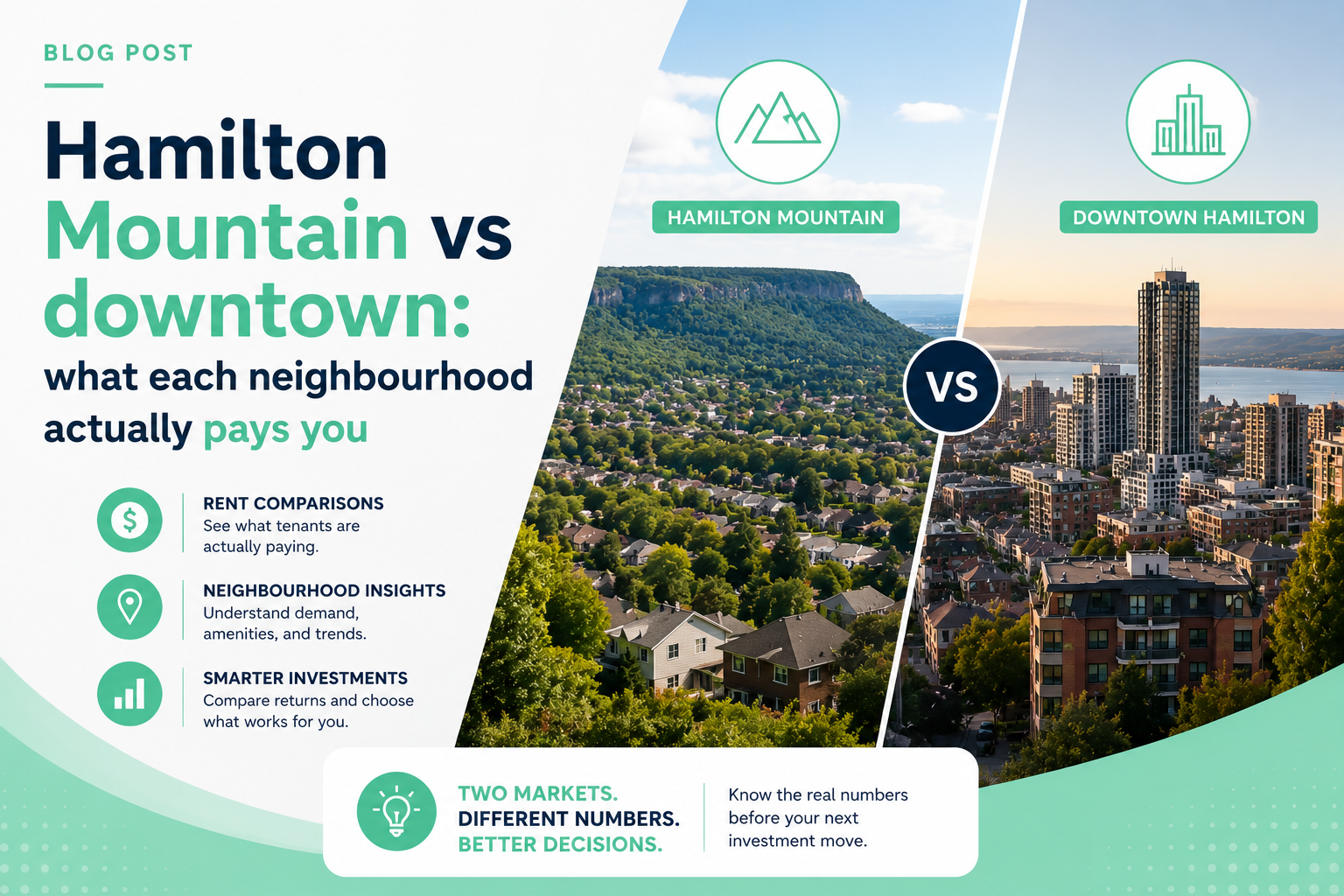
Most landlords I talk to bought their first Hamilton rental on instinct. They liked a street, the numbers looked fine on a napkin, and they signed. Then the realities show up: a downtown duplex that rents fast but turns over every year, or a Mountain bungalow that sits quiet for a decade and barely covers the mortgage. Both can be good buys. They are good in completely different ways, and the gap between them is the whole point of looking at Hamilton rental income by neighbourhood instead of by city average.
I run Found Spaces. We manage more than 600 units across Hamilton and the surrounding area, from Ward 2 walk-ups to Stoney Creek Mountain townhomes. Here is how the two halves of this city actually behave when you own the building.
The headline rents are closer than people think
The myth is that downtown commands a premium. The reality in 2026 is messier.
A one-bedroom in the downtown core (Ward 2, the blocks around James North and King William) averages around $1,771, with most units landing between $1,350 and $2,200. Two-bedrooms downtown run closer to $1,998. On Hamilton Mountain, two-bedrooms span a wide $1,350 to $2,810 depending on whether you are near Concession or out toward Upper Paradise. Stoney Creek sits slightly higher at the top end, $1,400 to $2,900.
So the rent ceiling is similar. What differs is everything underneath the rent.
Downtown: higher turnover, faster lease-up
Downtown units lease fast. A renovated one-bedroom near the GO station can get 30 applications in a weekend. That speed is real money when a unit goes vacant, because you are not carrying an empty suite for six weeks.
The trade-off is churn. Our downtown tenants skew younger and more mobile. They take jobs in Toronto, they buy, they move in with a partner. We see more one-year tenancies downtown than anywhere else in our portfolio. Every turnover costs you: paint, cleaning, a few weeks of lost rent, and the leasing effort. A unit that re-rents for $50 more but turns every year often nets less than a quieter unit that holds the same tenant for five.
The Mountain: slower, stickier, cheaper to hold
Mountain tenancies last. Families rent the lower half of a bungalow on the central Mountain (Ward 7 and Ward 8) and stay six, seven, eight years. Vacancy is rare and re-leasing is calm. You also buy in cheaper. The Mountain’s average property price sits around $696,860, down 3.9% from last year, while detached homes across Hamilton average closer to $859,000.
Lower purchase price plus comparable rent is the entire investor case for the Mountain. The Mountain and Stoney Creek consistently produce the strongest gross yields in our book. You give up the downtown energy and the quick lease-up, and in exchange you get a building that mostly runs itself.
The number that changes the math in 2026: vacancy
Here is the part too few owners are pricing in. Hamilton’s vacancy rate climbed to 3.6% in 2025, the highest since before the pandemic. Two things drove it: fewer international students, and a wave of new condo supply hitting the rental pool. Roughly 4,200 purpose-built rental units are under construction in this city right now, with about 1,400 expected to deliver in 2026.
That matters more downtown than on the Mountain. Almost all the new purpose-built and condo supply is going up in the lower city and along the LRT line. If you own a downtown one-bedroom, you are about to compete with brand-new buildings offering a month free and a gym. The Mountain has far less new supply, which is one reason Mountain rents and occupancy have held steadier.
If you bought downtown for appreciation and easy rent growth, the next 18 months will test that. If you bought the Mountain for boring, durable income, this is the market you were built for.
A real example from Ward 3
We took over a fourplex in Ward 3, just east of downtown near Gage Park, where the previous owner self-managed and chased top-of-market rent on every turnover. On paper the rents looked great. In practice three of the four units had turned over twice in three years. He was losing roughly six weeks of rent per turnover plus make-ready costs, so his actual collected income trailed his advertised rent by close to 15%.
We did two things. We re-set the rents slightly below the screaming top of market to attract tenants who would stay, and we collected last month’s rent deposit properly on every new lease, which he had been skipping. (Worth saying clearly: last month’s rent deposit is the only deposit Ontario law allows. There is no such thing as a legal damage deposit here, and charging one creates problems at the Landlord and Tenant Board, not protection. If a deposit or eviction issue is already on your plate, that is exactly what our landlord legal services handle.) Within a year, turnover dropped to one unit, and his real income rose even though his posted rents were marginally lower. That is the downtown lesson in one building: chase retention, not the headline.
How to read your own neighbourhood
A few practical filters we use when an owner asks whether to buy Mountain or lower city:
Look at your holding cost, not just your rent. A Mountain bungalow at $696,000 with a stable family tenant can out-earn a downtown unit that rents for more but costs more to buy and turns constantly.
Count realistic vacancy. Downtown, budget for faster re-lease but more frequent turnover. On the Mountain, budget for rare vacancy but a longer lease-up when it happens, since the tenant pool is smaller.
Watch new supply on your block. If three towers are rising within walking distance, your rent growth is capped for a while no matter what the city average says.
Why owners hand this to us
We are not a national chain pulling numbers off a dashboard. We lease, inspect, and re-rent in these neighbourhoods every week, so we know that a two-bedroom near Concession behaves nothing like a two-bedroom near Augusta. We price units to the street, not the city. We handle the deposit and lease compliance correctly the first time, which keeps you out of LTB trouble. And because we manage across both the lower city and the Mountain, we can tell you honestly which one fits the income you actually want.
If you own in one part of Hamilton and you are weighing the other, or you just want a straight read on what your current building should be earning, I am happy to look at the numbers with you. Here is how to work with us. No pitch, just an honest assessment from people who manage these streets.

Kate Mackay is the founder and CEO of Found Spaces Property Management, managing over 600 rental units across Hamilton, Stoney Creek, Ancaster, Dundas, and the greater Hamilton area. She built Found Spaces from the ground up starting in 2017 and specializes in full-service property management for residential landlords and real estate investors.