
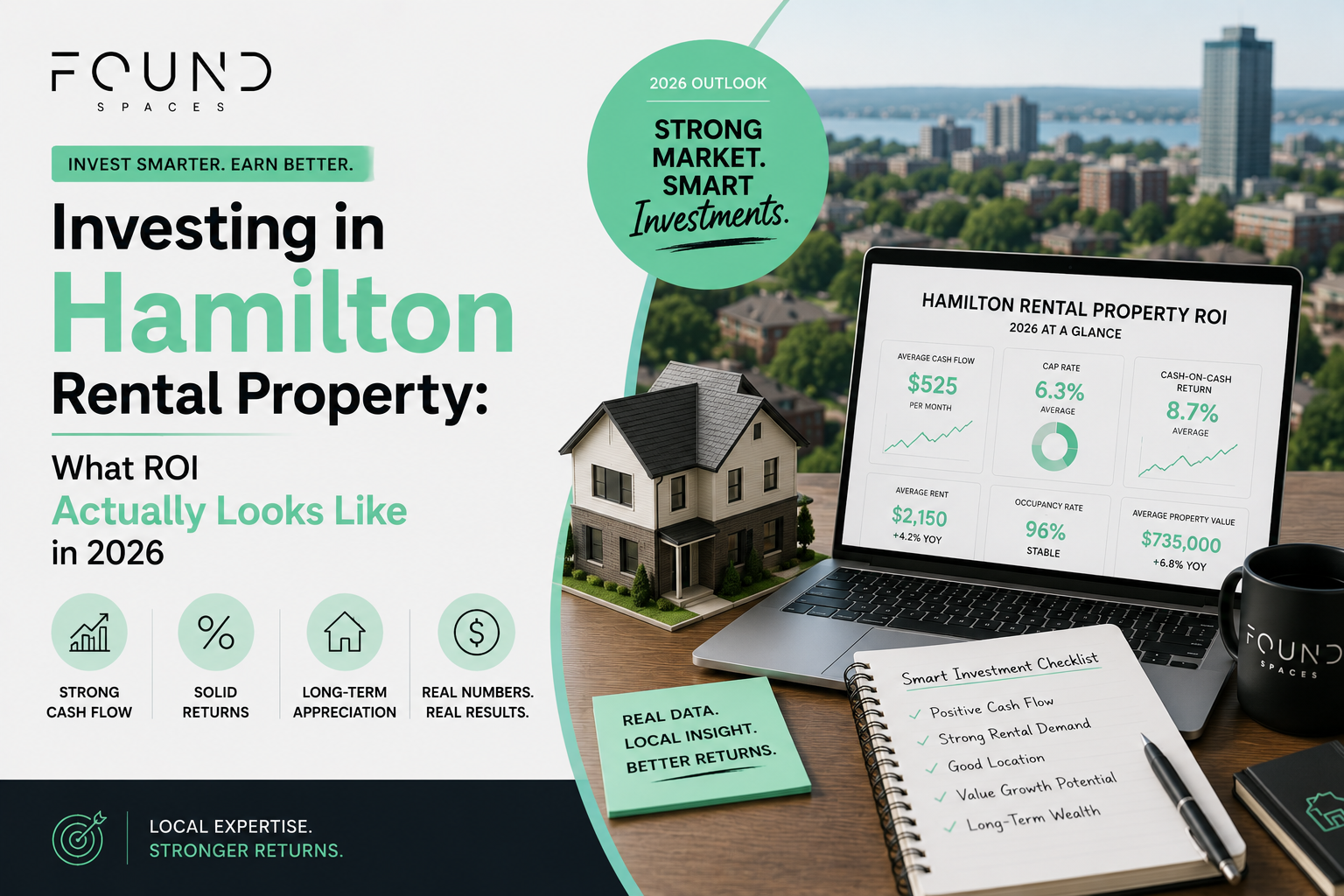
Let’s talk about what ROI actually looks like in 2026 in Hamilton. Every week I talk to someone who wants to buy a rental in Hamilton and expects it to cash flow $500 a month with 20 percent down. I have to be the one to tell them that math stopped working around 2021. What I can tell them is what the real numbers look like in August 2026, because we manage 600+ units across this city and I see the rent rolls, the repair bills, and the vacancy gaps every single day.
If you are considering a Hamilton rental property investment this year, here is the honest version.
The 2026 numbers you need to underwrite with
Start with what things cost. The average Hamilton sale price sat around $765,000 in July 2026, with detached homes averaging about $829,000 (down 8.1 percent year over year), semis around $648,000, and townhouses around $644,000. Prices have come off their 2022 peak by a wide margin, which is exactly why investors are looking again.
Now the income side. One-bedroom units in Hamilton are renting around $1,650 to $1,680, and two-bedrooms around $1,990 to $2,120 depending on the source and the neighbourhood. Two-bedroom asking rents are down roughly 5 percent from a year ago. Vacancy has climbed to about 3.6 percent, the highest CMHC reading since the pandemic. Units that sat on the market for four days in 2023 now take three to six weeks if they are priced wrong.
And on rent growth: the Ontario rent increase guideline for 2026 is 2.1 percent, the lowest in four years. For any building first occupied before November 15, 2018, that guideline caps your annual increase for sitting tenants. Do not underwrite 5 percent annual rent growth. You will not get it.
What cap rates look like across Hamilton right now
Small multi-family properties (duplex to fourplex) in Hamilton are trading at gross cap rates between roughly 4.2 percent in Ancaster and Dundas and 5.8 percent in the east end. The lower city and east Hamilton, wards 3 and 4 especially, carry the best yields because purchase prices are lower relative to achievable rents. The trade-off is older housing stock, which means higher maintenance reserves.
We wrote a full breakdown of which Hamilton neighbourhoods produce the strongest rental income, comparing the Mountain against downtown block by block. Short version: the Mountain gives you steadier tenancies and lower turnover, the lower city gives you higher yield per dollar invested.
A real deal, with the real math
Here is what a typical east-end deal pencils out to right now. Say you buy a legal duplex in Crown Point for $620,000 with two two-bedroom units renting at $1,950 each.
The income
Gross rent is $3,900 a month, or $46,800 a year. Budget 35 percent for operating costs: property tax, insurance, water, maintenance reserve, and a vacancy allowance that respects the 3.6 percent market reality. That leaves a net operating income around $30,400, which is a 4.9 percent cap rate.
The financing
Put 20 percent down ($124,000) and finance $496,000. The best five-year fixed rates were around 3.94 to 4.04 percent in early August 2026, but investment property mortgages price higher, so call it 4.6 percent. Your payment lands near $2,770 a month, or about $33,300 a year.
The verdict
NOI of $30,400 minus debt service of $33,300 means this property runs roughly $240 a month negative before you pay yourself anything. That surprises people. But the mortgage paydown is close to $11,000 in year one, so your actual first-year return is around $8,000 on roughly $140,000 invested including closing costs. That is about 5.7 percent before any appreciation, on an asset you bought well below its 2022 price.
Buying in Hamilton in 2026 is a basis play and a paydown play, not a cash flow play. If a listing agent shows you a pro forma with $600 monthly cash flow at 20 percent down, they left something out. Usually maintenance, vacancy, or both.
Where investors lose money in this market
Three mistakes show up constantly in the buildings we take over.
First, overpricing units into a 3.6 percent vacancy market. A unit listed $100 above market that sits empty for six weeks costs you more than a year of that $100 would have earned. Our mid-year Hamilton rental market report covers current asking rents by unit type so you can price against real data.
Second, ignoring the capital condition of pre-1950 lower-city stock. Knob and tube, galvanized plumbing, and 60-amp panels are common east of Sherman. Budget for them or pay for them at the worst possible time.
Third, underwriting rent increases that rent control will not allow. Collect a last month’s rent deposit (which is permitted in Ontario) and set the starting rent right, because for a sitting tenant in a rent-controlled unit, 2.1 percent is what you get this year.
What we saw inside a Ward 3 fourplex
Last fall we took over a fourplex in Ward 3 where the owner had self-managed for nine years. Rents were $1,150 to $1,300 on units that should have been at $1,800, a gap of roughly $27,000 a year across the four units. He had never issued a guideline increase because he was worried about the paperwork, and he had never repositioned a unit at turnover. Within twelve months, through two natural turnovers repositioned at market rent and proper annual increases on the remaining units, the building’s gross income rose by $14,400 a year. Nothing exotic. Just running the asset like a business.
That is most of what professional management is: pricing discipline, legal increases filed on time, and turnovers that take days instead of months. It is the difference between a 3 percent return and a 6 percent return on the same building.
Is 2026 a good year to buy in Hamilton?
If you need immediate positive cash flow at 20 percent down, mostly no. If you have 25 to 35 percent down, a five-plus year horizon, and the discipline to buy in the right pocket at the right basis, this is the best buying window Hamilton has offered since 2019. Prices are down, sellers negotiate, and the construction pipeline that pushed vacancy up will thin out in 2027 and beyond.
If you want a second set of eyes on a deal, or you own a Hamilton rental that is not performing the way the spreadsheet promised, our rental property management team reviews investor pro formas all the time. Send us the numbers and we will tell you what we would actually expect the building to do. No charge for the honesty.

Kate Mackay is the founder and CEO of Found Spaces Property Management, managing over 600 rental units across Hamilton, Stoney Creek, Ancaster, Dundas, and the greater Hamilton area. She built Found Spaces from the ground up starting in 2017 and specializes in full-service property management for residential landlords and real estate investors.