
You served the N4. You filed the L1. You waited months for a hearing date. Then, on the morning of the hearing, the tenant arrives with a list of repair complaints you have never heard before, and the next hour is about a dripping faucet instead of the $5,400 they owe.
At an LTB arrears hearing Ontario, every Hamilton landlord who has sat through an LTB arrears hearing in Ontario knows that script. Since September 21, 2026, running it costs the tenant something.
What the half-arrears rule says
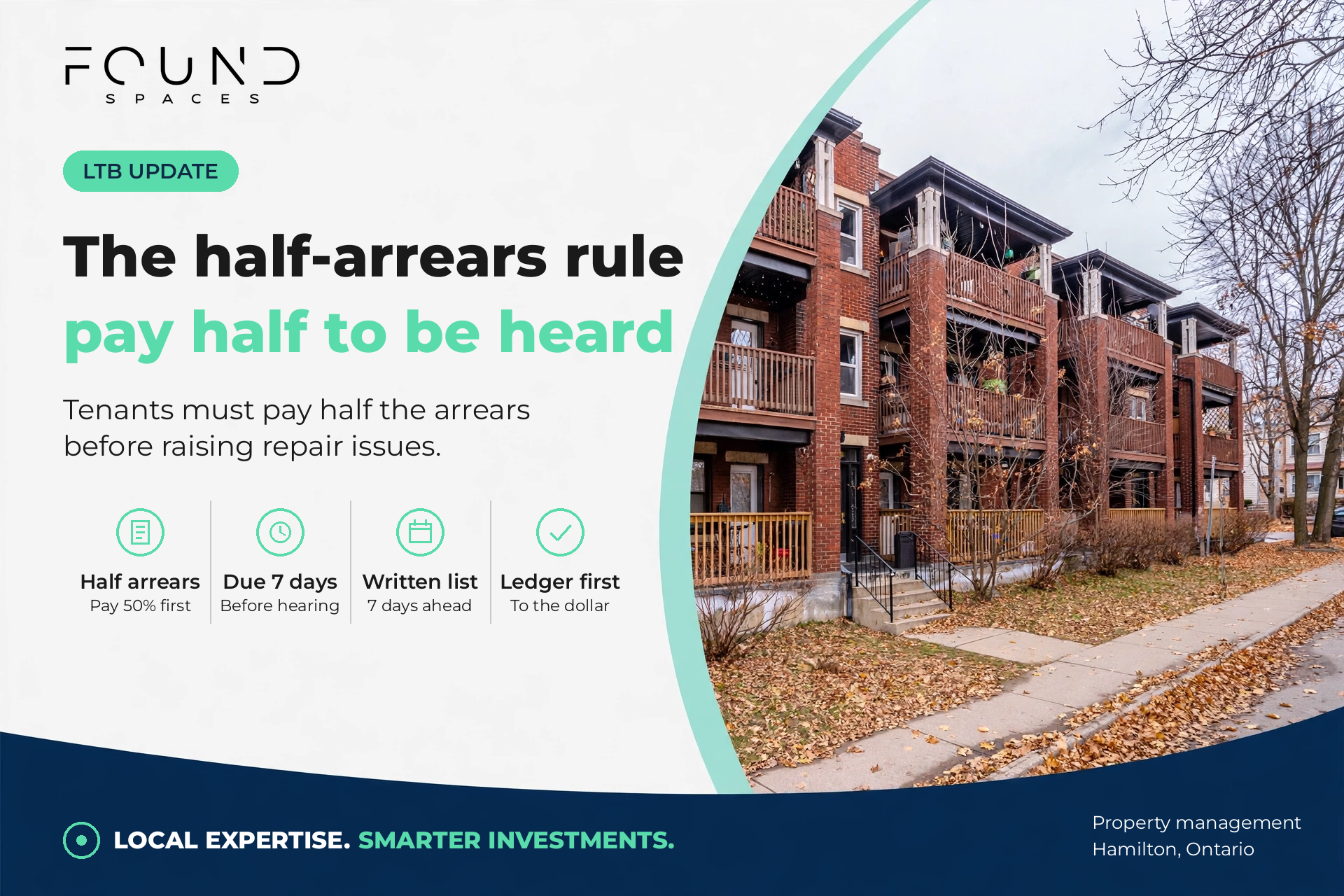
For any L1 application filed on or after September 21, 2026, a tenant who wants to raise other issues at the non-payment hearing — an LTB arrears hearing Ontario — (maintenance problems, tenant’s rights complaints, anything they could have filed their own application about) must first pay the landlord half of the rent arrears claimed in the application. The payment is due at least seven days before the hearing.
Three details matter here, and all of them come straight from the Tribunals Ontario operational update of September 21, 2026:
- The money goes directly to the landlord. The LTB will not hold it in trust.
- The tenant should keep a receipt as proof of payment.
- The older requirement still applies: the tenant must give the landlord and the LTB a written description of every issue they intend to raise, at least seven days before the hearing.
The LTB updated Interpretation Guideline 11 (Rent Arrears) on the same day to reflect this.
What the rule does not do
The rule gates one thing: raising unrelated issues inside your arrears application at an LTB arrears hearing Ontario. It does not take away a tenant’s other options.
- The tenant can still dispute the arrears figure itself without paying anything.
- The tenant can still file a separate T2 or T6 application about maintenance. There is no payment condition on those.
- The tenant can still void the N4 by paying everything owing before the order issues.
- If you filed the L1 before September 21, 2026, the old rules apply to that file, even if the hearing lands in 2027.
Why the arrears figure on your L1 now matters more at an LTB arrears hearing Ontario
Half of what you claim is the price of admission. That cuts both ways.
Say you file an L1 claiming $6,258 in arrears, which is three months of a two-bedroom at Hamilton’s average rent of $2,086 (our Hamilton rental market report has the full breakdown by unit type). The tenant now needs $3,129 in your hands seven days before the hearing to get their maintenance complaints heard.
If your ledger is sloppy and the real number is $5,800, the tenant has an argument that the threshold was wrong. If you forgot a partial payment, the member will find it. The arrears on an L1 are rent only, so NSF charges, utilities, and damage do not belong in that figure. Keep them off.
Your ledger needs to reconcile to the dollar before you file, and again before you submit the L1/L9 Information Update form, which is due at least five business days before the hearing.
A Ward 3 fourplex example
We took over a fourplex in Ward 3, off Barton Street East near Sherman Avenue North, in early October. One tenant paying $1,800 a month had stopped paying in July over a bathroom fan that did not work and a cracked kitchen window. The previous owner had served the N4 and filed the L1 in late September claiming $5,400.
Under the new rule, that tenant needed to pay $2,700 at least seven days before the hearing to raise the fan and the window at an LTB arrears hearing Ontario. They also needed to send the written list of issues.
We did two things in our first week. We replaced the fan and the window glass (under $400 all in) and documented both with dated photos and the contractor invoice. We also reconciled the ledger and found a $200 e-transfer from August the previous owner had never recorded. The L1/L9 update went in with the corrected figure of $5,200.
The tenant never paid the half. The hearing stayed on the arrears, the maintenance complaints were not heard, and the order issued for the full amount plus the filing fee. Had the tenant paid the $2,600, the member would have seen fixed problems and a landlord who had already acted.
What this means for the hearing itself
At an LTB arrears hearing Ontario, arrears hearings stay on the money now. That is the point of the change.
Two related changes landed on the same date. The LTB’s power to delay an eviction after an arrears hearing is narrower: unless the landlord agrees, the member must be satisfied that a delay would not be unfair to the landlord and that there are compelling reasons for it. And the N4 notice period dropped from 14 days to 7 for notices given on or after September 21.
What has not changed much is the wait. L1 hearings in 2026 are still running roughly three to six months from filing, depending on region and adjournments. We track this in our post on LTB hearing timelines after Bill 60.
What to do before every L1 hearing now
- Reconcile the ledger before you file. The arrears claimed on the L1 should match your rent roll exactly.
- Use the current forms. The LTB replaced the N4, L1, L2, L9 and others on September 21, and it will reject the old versions as of November 30, 2026.
- Calendar the seven-day mark. If a written list of issues or a half-arrears payment arrives, you have one week to prepare your response and gather your own evidence. The LTB’s disclosure rule wants your evidence filed at least seven days ahead as well.
- Fix what can be fixed before the hearing. The rule limits when a tenant can raise maintenance inside your application. It does not change your obligations under section 20 of the RTA. A completed work order with photos beats any argument.
- Receipt every payment. If the tenant pays the half, issue a written receipt, record it in the ledger, and update the L1/L9 form.
- Collect the last month’s rent deposit at move-in. It is the only deposit Ontario allows, and it keeps the final month from becoming one more unpaid line on the ledger.
How Found Spaces runs arrears
We manage more than 600 units across Hamilton, from the lower city to the Mountain, Dundas and Stoney Creek. Arrears are a weekly workflow for us, not an occasional crisis.
Rent is due on the first. Our team serves the N4 within days if it has not arrived, files the L1 the day after the termination date, and keeps the ledger reconciled so the arrears figure on the application is never a guess. Our retained paralegal handles the hearing. Our LTB and eviction support service covers the filing and the hearing for owners who manage their own buildings. Owners on our full rental property management service get this built in, along with the maintenance response that keeps a tenant’s complaint list short.
If you have an L1 pending
If you filed an L1 after September 21 and a hearing — an LTB arrears hearing Ontario — is coming up, check two things this week: that the arrears figure reconciles to your ledger, and that any maintenance request on file has been dealt with and documented. If you want a second set of eyes on the file before the hearing, reach out. We are happy to look.
Kate Mackay
Founder & CEO, Found Spaces Property Management Inc.
[email protected] | (289) 270-2922

Kate Mackay is the founder and CEO of Found Spaces Property Management, managing over 600 rental units across Hamilton, Stoney Creek, Ancaster, Dundas, and the greater Hamilton area. She built Found Spaces from the ground up starting in 2017 and specializes in full-service property management for residential landlords and real estate investors.