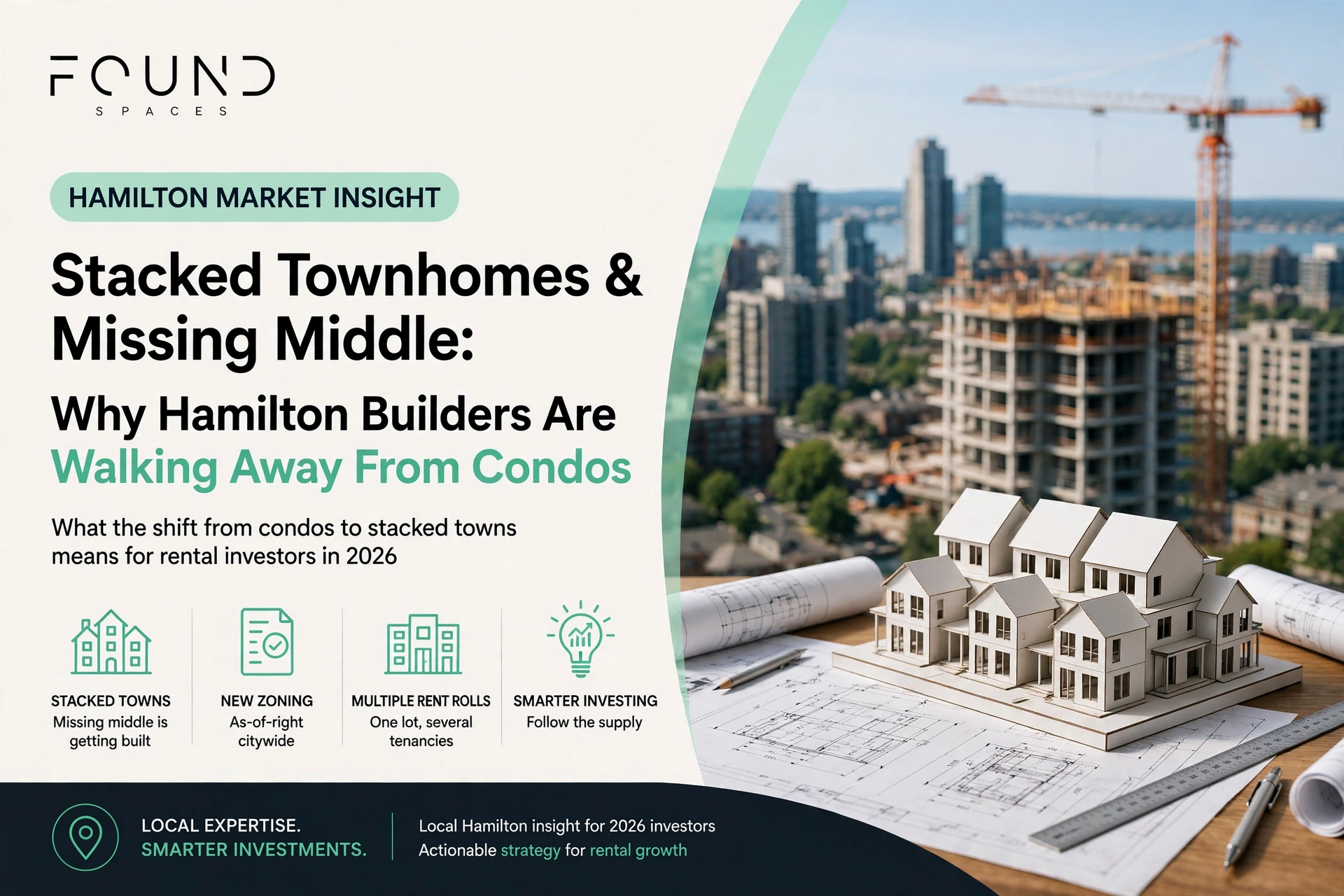
I had a call in August with an investor who’d put a deposit down on a downtown Hamilton condo unit back in 2022. He’s still waiting on it. The tower hasn’t broken ground. Meanwhile, he watched a 21-unit stacked townhome project in Waterdown sell out its first release in a matter of weeks. He asked me, more or less, “did I bet on the wrong horse?” — and whether Hamilton missing middle housing was the better bet all along.
Honestly, a lot of Hamilton investors are asking some version of that question right now. The answer isn’t simple, but the direction of the market is. Condos are stalling. Stacked towns, block towns, and small multiplexes are what’s actually getting built, financed, and rented out.
Condo towers aren’t moving, and it isn’t a Hamilton-only problem
Toronto started just 156 new condo units in the first half of 2026, against a decade-long average of roughly 7,000 units a year. That’s a market that’s basically stopped building condos for sale. Purpose-built rental apartments now account for two-thirds of all apartment starts across Canada’s major markets, and in Toronto, rental apartment starts jumped 82 percent in the first half of 2026 versus a year earlier, outpacing condo starts for the first time since 1994.
What’s replacing the condo pipeline in Hamilton
Hamilton is living the same pattern. Downtown, the City Centre site (the old Jackson Square mall block) has sat with demolition on hold since December 2023, when the developer, IN8 Developments, said publicly it needed roughly 500 presales on a planned 2,000-unit project before it would move forward. As far as I know, it still hasn’t. That’s a condo project, and it’s frozen.
What’s not frozen: purpose-built rental. CMHC data shows about 4,200 purpose-built rental units currently under construction across Hamilton, with roughly 1,400 of those opening in 2026, including a 261-unit building at 500 Upper Wellington Street and a 126-unit project near Upper Wentworth. I wrote about what that pipeline means for vacancy and rents in our CMHC Hamilton housing outlook. The short version: vacancy sat at 3.6 percent in 2025, the highest since the pandemic, and CMHC expects it to settle closer to 3.0 percent through 2027.
Hamilton missing middle housing is now legal almost everywhere
This is the part most landlords haven’t caught up on yet. As of August 11, 2026, Hamilton’s city-wide residential mid-rise zoning is in force. Combined with the low-density zoning changes from a few years earlier, here’s what’s now allowed as-of-right, no committee of adjustment, no minor variance, across most of the city:
- Single-family and semi-detached homes, street townhouses, triplexes, and fourplexes in low-density residential zones
- Stacked townhouses, block townhouses, and apartment buildings from 6 to 12 storeys along main roads and at major intersections, under the new mid-rise zone
That’s Hamilton missing middle housing going from a planning buzzword to something you can build on a normal residential lot without a fight at council. The city’s own framing leans on some blunt numbers too: Statistics Canada data shows millennials aged 25 to 39 are about twice as likely to be living with their parents as baby boomers were at that age, and a 2026 Missing Middle Initiative report found 88 percent of Ontario non-homeowners under 30 still want to own a home someday. There’s a lot of demand stacked up behind a housing type nobody’s been allowed to build for decades.
You can see it in what’s actually getting built. New Horizon Development Group’s SOL Stacked Towns, a 21-unit project at 90 Skinner Road in Waterdown East, is launching one-storey units from $399,990 and two-storey units from $649,990, ranging 672 to 1,362 square feet with three-bedroom, 2.5-bath layouts. That’s a builder choosing Hamilton missing middle housing over a mid-rise condo tower, and pricing it to sell fast.
What this means if you’re buying rental property in Hamilton right now
I manage everything from single-family homes to fourplexes to small apartment buildings, so I’m not neutral here, but the math is the math. A stacked townhome or a fourplex on a freehold lot gives you multiple rent rolls, no condo board, no special assessment risk, and (this is the part investors underweight) a building type the market is actually delivering right now instead of one stuck in a presale queue.
A scenario from our own portfolio
We took over management of a fourplex in Ward 3 last year for an owner who’d originally planned to buy a downtown condo instead. He pivoted after watching his condo deposit sit untouched for two years. The fourplex rents at roughly market ($1,650 to $1,900 a unit, in line with current Hamilton averages) across four separate tenancies, so a vacancy in one unit doesn’t wipe out his monthly cash flow the way it would in a single condo. He also collects last month’s rent as a deposit on each unit, standard and fully legal in Ontario (there’s no separate “damage deposit” here, so don’t structure a lease around one).
What I tell clients weighing the two options
If you’re weighing a condo purchase against a stacked townhome or small multiplex play, a few things I tell clients directly:
- Freehold multi-unit properties spread your vacancy risk across several rent rolls instead of one.
- No condo fees or board decisions eating into your net operating income.
- The financing conversation with your lender is different (appraisal-based for multi-unit, not comparable-sale-based like a condo), so loop in a mortgage broker who’s actually done a fourplex deal before.
- Hamilton missing middle housing stock in established neighbourhoods tends to rent to longer-term tenants (families, downsizers) rather than the churn you often see in downtown condo towers.
For a broader read on where Hamilton neighbourhoods are outperforming on rental income, our Hamilton Mountain vs downtown rental income breakdown is worth a look before you commit to a specific area.
Where Found Spaces fits into this
We manage over 600 units across Hamilton and the surrounding area, and a growing share of that portfolio is exactly this kind of Hamilton missing middle housing: fourplexes, stacked towns, and small multiplex buildings, not condo units. That’s where the supply is going, and it’s where we’ve built the operational muscle, separate utility setups, multiple leases per address, staggered turnover, that a single-unit condo manager doesn’t need. If you’re evaluating a missing middle purchase and want a read on realistic rents and expenses before you close, that’s a conversation I have with investors every week.
The zoning changes are new. The Ontario government’s current 2026 rent increase guideline sits at 2.1 percent, the lowest in four years, and you can see the full detail on the Ontario rent increase guideline page. Worth checking before you set next year’s rent on any unit, missing middle or otherwise.
A quick note before you buy
None of this means condos are dead everywhere, or that every stacked townhome pencils out. It means the building types getting financed and delivered in Hamilton right now have shifted, and your investment strategy should account for that. If you’re not sure whether a specific property or building type fits your goals, or you want a hand thinking through the numbers on a Hamilton missing middle housing purchase, reach out. I’m happy to walk through it with you, no pressure either way.

Kate Mackay is the founder and CEO of Found Spaces Property Management, managing over 600 rental units across Hamilton, Stoney Creek, Ancaster, Dundas, and the greater Hamilton area. She built Found Spaces from the ground up starting in 2017 and specializes in full-service property management for residential landlords and real estate investors.