A landlord with a duplex on Whitney Avenue in Ward 1 called me last month with the invoice from his licence renewal in one hand and a quote for a $1,400 handrail and egress fix in the other. His question was simple. What am I actually paying for?
Fair question. Hamilton rental licence fees are the one part of the program nobody explained well. I have watched landlords budget for the wrong number, skip the renewal, or assume the fee was the whole cost. It is not.
Who pays Hamilton rental licence fees
If you own a detached house, a townhouse, or a building with five or fewer self-contained units in Ward 1, Ward 8, or the parts of Ward 14 closest to McMaster and Mohawk, you need a licence for every rented unit. The program has been permanent since January 1, 2026, when Council adopted staff report PED21067(g). Buildings with six or more units are out of scope. So are hotels, lodging homes, and short-term rentals.
That covers most of Westdale, Ainslie Wood, Kirkendall, and the Chedoke area in Ward 1, plus Westcliffe, Buchanan, Yeoville, Gilkson, and Bonnington on the Mountain in Ward 8. If you are unsure, the City’s address lookup on the Rental Housing Licence page settles it in thirty seconds.
What the licence fee is
The City set up the program on a full cost-recovery basis. Council approved a program budget of $2,147,055 for the two-year pilot, with zero impact on the tax levy, on the assumption that 2,000 units would be licensed each year. Work that out and the City was targeting roughly $537 per unit per year to break even.
The published fee schedule for 2026 sits in the range of $875 to $1,000 per unit for a first-year application, and $500 per unit for each annual renewal. So a legal triplex in Ward 8 runs roughly $2,600 to $3,000 to get licensed in year one, then $1,500 a year after that.
The fee is per unit, not per building. That trips up owners of duplexes and triplexes who assume one application covers the property.
What the fee actually buys
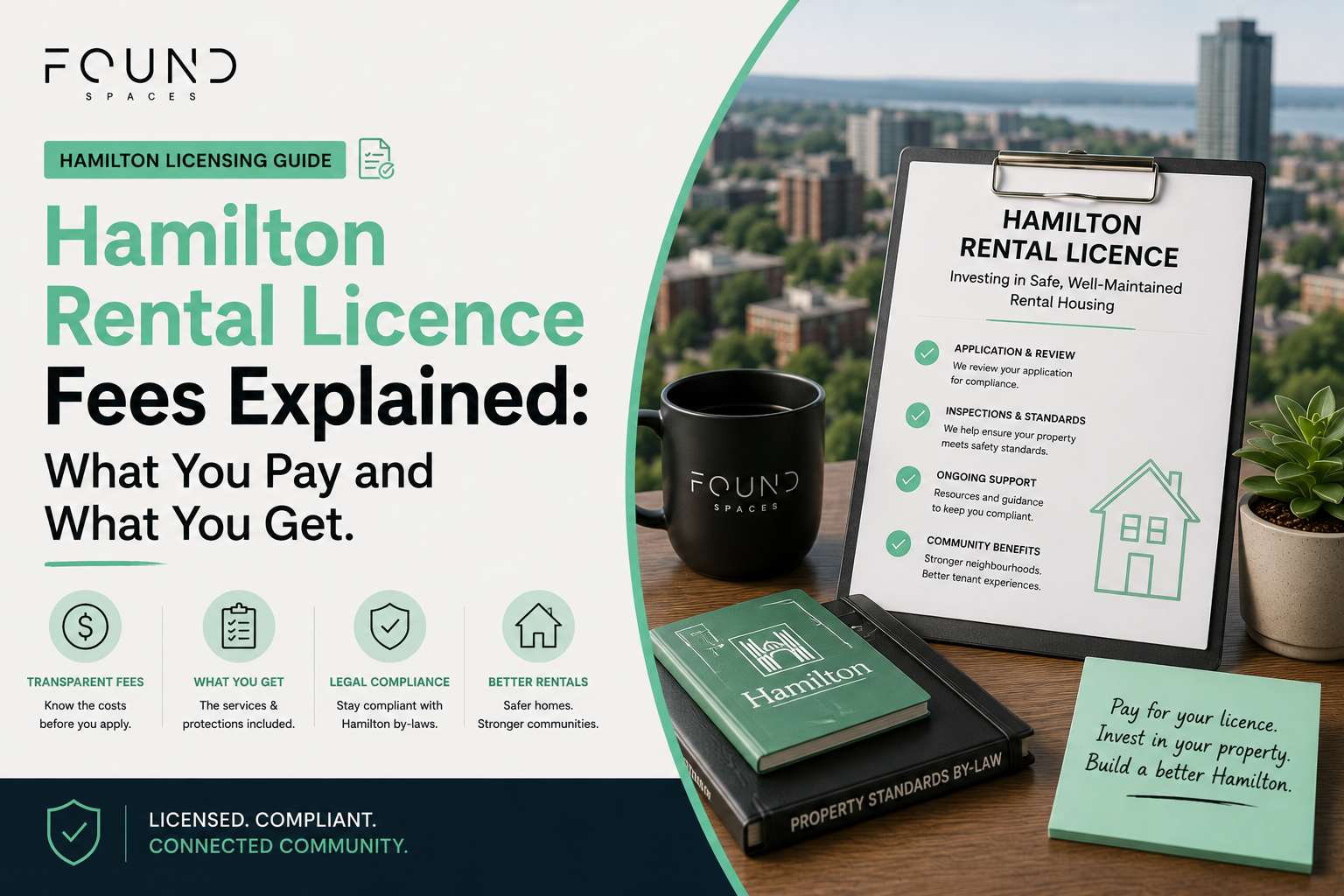
The fee pays for the City’s process, not your compliance. Here is what it covers:
- A Licensing Compliance Officer’s property standards inspection, interior and exterior, against the Rental Dwelling Checklist.
- A Hamilton Fire Department fire safety inspection.
- Zoning verification, which confirms your unit is a permitted use.
- Administration of the licence itself, including the annual renewal.
That is it. Anything the inspectors find is on you.
The costs that are not in the fee
This is the number most landlords miss. In my experience across the licensed properties we manage, the licence fee is usually the smallest line item in year one. The bigger costs:
Liability insurance. You need a certificate showing $2 million per occurrence, naming the property as a rental. Most landlords already carry this, but if you are on a standard homeowner policy the upgrade can add $300 to $800 a year.
Electrical inspection. The City requires documentation from a licensed ESA contractor confirming the unit meets the Ontario Electrical Safety Code. Budget $250 to $500 for the inspection alone, more if the electrician finds ungrounded outlets or an overloaded panel.
Floor plans. You need a dimensioned plan for each unit. A drafting service in Hamilton charges $150 to $400 per unit.
Remediation. Missing handrails, non-interconnected smoke alarms, a basement bedroom window that does not meet egress. Orders get issued and the licence does not get issued until they are cleared. On a 1950s Mountain bungalow with a finished basement unit, $2,000 to $6,000 in fixes is normal.
Add it up and a two-unit house in Ward 1 that has never been inspected can easily cost $5,000 to $9,000 to get licensed, with the actual licence fees making up less than a third of that.
A Ward 1 triplex that got expensive
We took over a triplex on a side street off Main Street West, near the Ainslie Wood plaza, in early 2026. The owner had paid the application fee during the pilot and assumed he was done. He had never followed up on the inspection.
When we pulled the file, there were three open orders: no fire separation between the basement unit and the furnace room, a missing CO alarm on the second floor, and a rear exit door that opened inward. Total cost to clear: about $3,800. The licence fees were a fraction of that. But the fines for operating without a licence run up to $1,000 per day, and the City had already sent a notice. He got lucky.
The lesson: paying the fee starts the clock. It does not finish anything.
Can you pass the fee on to tenants?
Not directly. Ontario does not allow landlords to charge tenants a licensing surcharge, and the rent increase guideline for 2026 is 2.1% regardless of what your costs did. You can collect a last month’s rent deposit at move-in, but there is no such thing as a damage deposit or a compliance deposit in Ontario. If licensing pushes your operating costs up in a way that qualifies, an above-guideline increase application is the only lawful route, and it takes months.
The fee comes out of your margin. On a Ward 8 semi renting at $2,400 a month, a $500 renewal is about 1.7% of annual gross. It belongs in your pro forma.
Where the program is heading
The City’s own numbers from the pilot are telling. By September 2024, staff had received 1,002 applications, completed 420 property standards inspections, and issued 289 licences. More than half of all applications came in only after proactive enforcement started. That gap between applications and licences issued is remediation, and it is where the money goes.
Council directed staff to report back on expansion to other wards. If you own rentals in Wards 2, 3, or 4, treat that as a matter of when, not if. Our Wards 1, 8 and 14 compliance checklist is a good starting point even if your property is not in scope yet.
How we handle licensing for owners
Found Spaces manages over 600 units across Hamilton, and a meaningful share of them sit inside the licensed wards. We run the licensing process end to end: address verification, insurance certificate, floor plans, pre-inspection walk-through to catch orders before the City does, and renewal tracking so nobody gets a $1,000-a-day surprise. Our earlier breakdown of what the Hamilton rental housing licence requires covers the documents in detail.
If you already have open orders or a notice from the City, our landlord legal support team can help you respond before it escalates.
What to do this week
Check your ward on the City’s map. Pull your last renewal date. If it has been more than 12 months, or you never received a licence after paying, call the Licensing Section at 905-546-2782 and ask for your file status. Then budget for the real number, not the fee on the invoice.
If you would rather hand the whole thing to someone who does it weekly, we are happy to walk through your property with you.

Kate Mackay is the founder and CEO of Found Spaces Property Management, managing over 600 rental units across Hamilton, Stoney Creek, Ancaster, Dundas, and the greater Hamilton area. She built Found Spaces from the ground up starting in 2017 and specializes in full-service property management for residential landlords and real estate investors.