
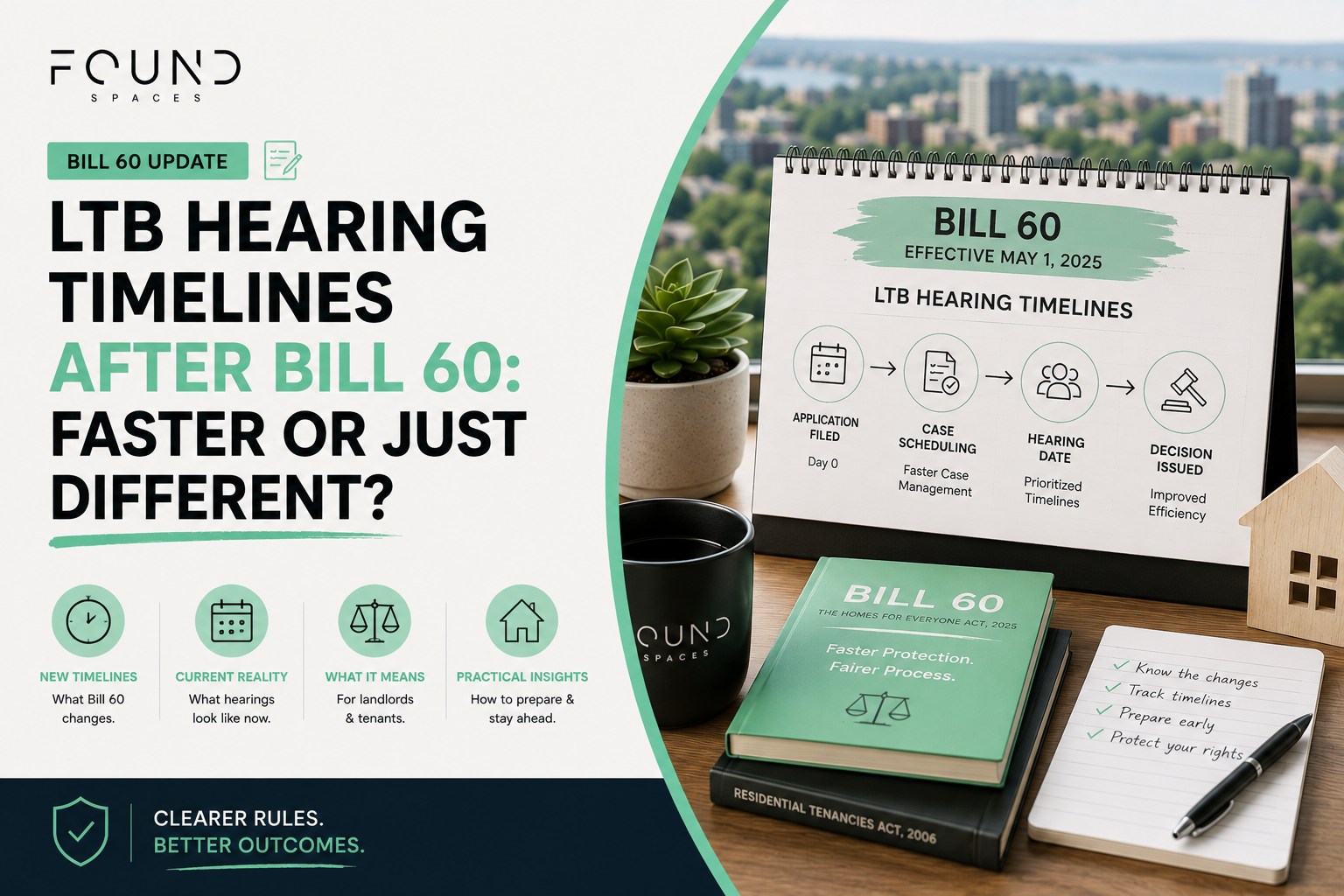
The LTB hearing timelines Ontario landlords face in 2026 is the question I get asked most. If you filed an L1 in Hamilton this summer, you’re probably wondering the same thing: is the Landlord and Tenant Board actually faster now, or did the rules just get more complicated?
Bill 60, the Fighting Delays, Building Faster Act, was sold as the fix for LTB delays. It received Royal Assent in November 2025, the first wave of changes took effect July 1, 2026, and a second wave lands this September. We manage over 600 units across Hamilton, and we’ve had files in front of the Board both before and after July 1. Here’s what has actually changed in the LTB hearing timeline in Ontario, and what hasn’t.
What changed on July 1, 2026 to the LTB Hearing Timelines
The July changes are mostly about deadlines and paperwork, not scheduling. According to the Tribunals Ontario operational update from June 30, 2026, the changes now in force include:
The review deadline was cut in half. You now have 15 days, not 30, to request a review of an LTB order. This cuts both ways. A tenant has less time to stall your eviction order with a review request. But if the Board gets something wrong in your order, you have 15 days to catch it and act. Read your orders the day they arrive.
Payment agreements now require the LTB’s official form. If you work out a repayment plan with a tenant in arrears, you must use the Board’s Payment Agreement Form. A handshake deal or an email thread no longer counts. This matters because a properly documented s.206 agreement lets you go back for an ex parte order if the tenant breaches it.
Fines doubled. Maximum fines for RTA offences are now $100,000 for individuals and $500,000 for corporations. If you’re tempted to cut a corner on notice requirements or an illegal lockout, the downside got much bigger.
Above guideline increase orders got tighter service deadlines too: 7 days to serve tenants instead of 14, and 5 days to file your certificate of service.
What lands September 21: the 7-day N4
The bigger operational change for most Hamilton landlords comes September 21, 2026. The termination period on an N4 notice for non-payment drops from 14 days to 7 for monthly tenancies. That means you can file your L1 application a week sooner than before.
On a $2,200 unit in Crown Point or on the central Mountain, one week of filing delay is roughly $500 of additional exposure. It adds up, but keep perspective: the notice period was never the bottleneck. The wait for a hearing is.
A few other Bill 60 measures, including the requirement that tenants pay 50 percent of claimed arrears before raising maintenance issues at a non-payment hearing, and mandatory advance disclosure of evidence, were not yet in force as of late August 2026. Don’t build your strategy around rules that haven’t been proclaimed.
So how long is the wait right now?
Current scheduling averages, based on Tribunals Ontario figures from spring 2026:
L1 and L9 applications (non-payment) are being scheduled in roughly 3 months. L2 applications, which cover N12 personal-use and tenant-fault evictions, are running 6 to 9 months. Most other application types sit around 5 to 7 months. Once you get a hearing, orders are typically issued within 30 days.
So the honest answer to the headline question: non-payment files are moderately faster than the worst of the backlog years. Everything else is still slow. Bill 60 shortened deadlines around the hearing. It did not add adjudicators, and scheduling capacity is still the constraint. Faster in places, but mostly just different.
A Ward 3 example of what the timeline looks like in practice
Earlier this year we took over a sixplex in Ward 3, near Barton and Sherman, where the previous owner had let two units run four months into arrears without serving anything. By the time we served N4s, filed the L1s, and got hearing dates, the total timeline from takeover to resolution was close to five months. One tenant entered a documented repayment plan and is still in the unit, paying on schedule. The other file went to an order.
The lesson is not that the Board is hopeless. It’s that every week you delay serving a notice adds a week to the back end. The landlords who get hurt worst by LTB timelines are the ones who wait two or three months hoping the situation fixes itself. And remember, the last month’s rent deposit you collected legally at lease signing covers the final month of the tenancy, not the arrears in the middle.
What to do differently under the new rules
Serve the N4 the day you’re legally allowed to. From September 21, that gets you to filing in 7 days.
Diarize 15 days from every order. The review window is short now, for you and for the tenant.
Put every repayment plan on the official form. It’s the difference between an enforceable agreement and a story you tell an adjudicator.
Get your paperwork perfect. A defective notice still sends you to the back of a 3-month line. Wrong termination date, wrong rent amount, missing signature: any of these can sink a file at the hearing.
If your case involves an N12 rather than arrears, the rules changed more substantially. We’ve written a full breakdown of the N12 and Bill 60 changes for Hamilton landlords covering compensation and the new notice options.
How Found Spaces handles LTB files
We prepare and file LTB applications for the properties we manage, and our landlord legal support service handles notices, filings, and hearing preparation. Because we run these files constantly, we know which errors get applications thrown out and how Hamilton hearing blocks are actually scheduling, not just what the posted averages say.
If you’re a Hamilton landlord staring down an arrears problem or trying to work out how the new deadlines apply to your situation, get in touch. A 20-minute conversation before you serve a notice is a lot cheaper than a dismissed application and three more months of waiting.

Kate Mackay is the founder and CEO of Found Spaces Property Management, managing over 600 rental units across Hamilton, Stoney Creek, Ancaster, Dundas, and the greater Hamilton area. She built Found Spaces from the ground up starting in 2017 and specializes in full-service property management for residential landlords and real estate investors.