Last spring a landlord called me about a two-bedroom on the Mountain that had been sitting empty for five weeks. He had decided to offer the next applicant a month free to get it filled, and he did it by writing the rent on the lease as $1,600 instead of the $1,750 he was actually asking.
He thought he was being generous. What he actually did was set his lawful rent at $1,600 for the entire life of that tenancy. Every future increase now gets calculated off the lower number, and there was a box on the lease built for exactly what he wanted to do. He did not use it.
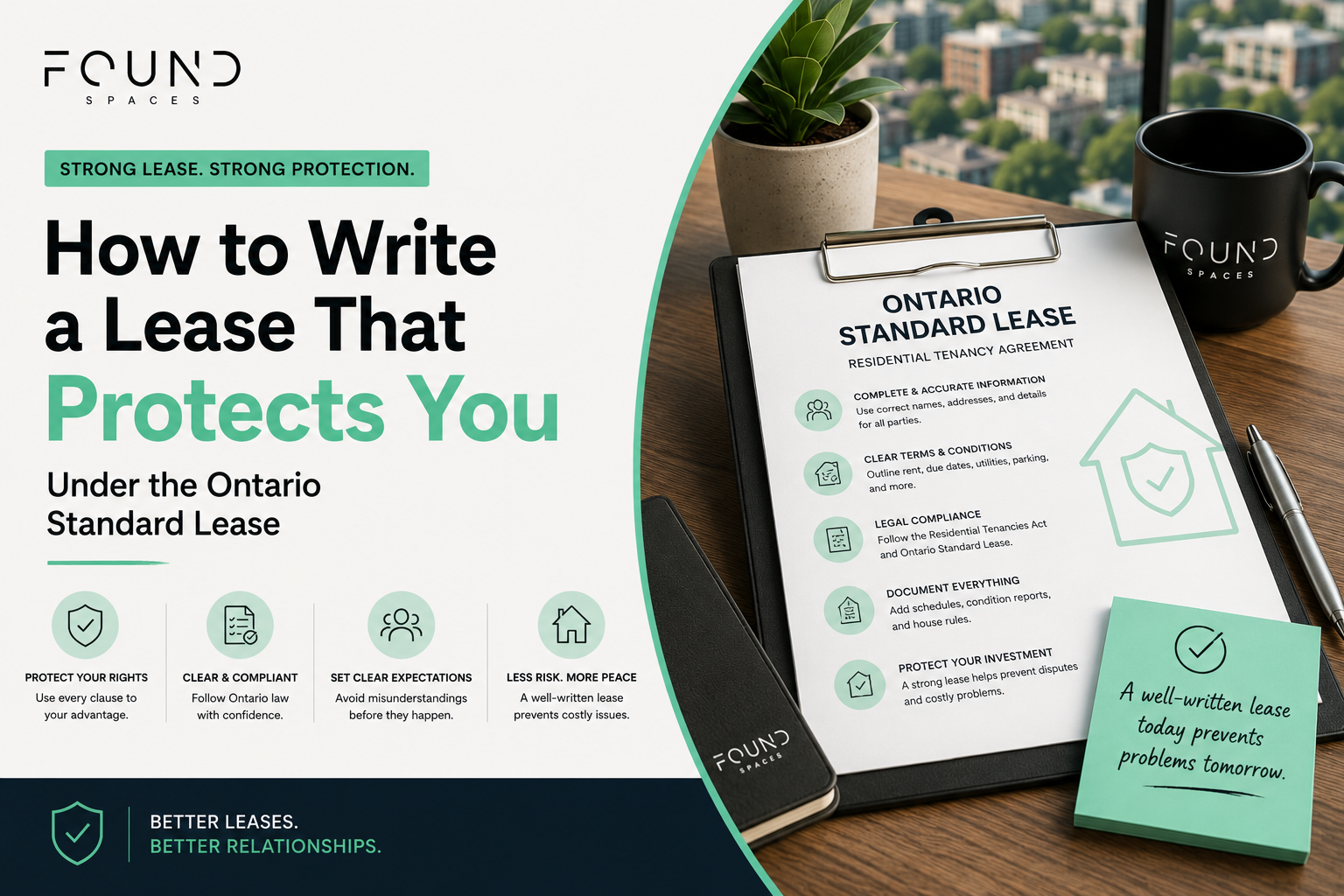
That is what most Ontario standard lease landlord tips come down to. The form is fixed and you cannot rewrite it, but there is more room inside it than owners realize, and the money gets lost in the sections people fill in without thinking.
The Ontario standard lease is not optional
Since April 30, 2018, the standard lease (Form 2229E) is required for most private residential tenancies in Ontario. Individual owners, numbered companies, property managers, all of us.
A tenant who did not get one can ask for it in writing, and you have 21 days to produce it. Miss that and the tenant can withhold a full month of rent. If you still have not delivered 30 days after that, they keep the money. On a $2,000 two-bedroom that is $2,000 gone because someone used a template downloaded from a US website. You also owe the tenant a signed copy within 21 days of them signing. The province’s guide to the standard lease sets all of this out plainly.
Section 5: write down every dollar you intend to collect
Section 5(a) is the base rent. Section 5(b) is where separate charges go, things like parking, a storage locker, or air conditioning.
Whatever you do not write down, you cannot start charging later. I have seen owners in Ward 2 hand over a laneway parking spot for free because it never made it onto the lease, then discover they cannot add $100 a month to an existing tenancy. In the lower city, where street permit parking is tight, we charge $75 to $150 a month for a dedicated spot.
Future increases are calculated on the total of 5(b), not just the base. The parking charge is not a side deal, it becomes part of the number that grows every year.
Section 7: put every incentive in the rent discount box
Vacancy in the Hamilton CMA has climbed to 3.6%, the highest reading since the pandemic, and incentives are back in listings across the city. Our mid-year Hamilton rental market report has the full picture on where rents landed.
If you offer a free month or a discounted period, section 7 is where it belongs. Write the real rent in section 5, record the discount in section 7. When the discount ends the tenant owes the full lawful rent, and every future increase builds off that higher figure. Do it the other way and you have permanently reset your rent.
Sections 8 and 9: what you can actually collect up front
You can collect a last month’s rent deposit. One month maximum for a monthly tenancy, and you owe the tenant interest on it every year at the guideline rate, 2.1% for 2026.
You can collect a key deposit, but only the actual cost of replacing the keys or fobs. Not a round $200 because it feels safer. If a fob costs $65, the deposit is $65, refundable when it comes back.
There is no damage deposit in Ontario. No pet deposit, no cleaning deposit, no security deposit. Putting one in section 15 does not make it enforceable.
Section 15: where you actually get to protect yourself
Sections 12, 13 and 14 cannot be changed. Extra detail on alterations, maintenance, or subletting goes in section 15 as an attached addendum, in plain language, at 10 point type or larger.
Terms that hold up
These describe conduct specific to the property:
- The exact parking spot number and whether guest parking exists
- Who clears which walkway and driveway, by name and by date range
- Garbage and green bin set-out rules, including where bins live between pickups
- Which utility accounts the tenant transfers and by what date
- Condominium declaration, bylaws and rules where the unit is a condo
- Shared laundry, yard use, or a shared basement in a converted duplex
Terms that get thrown out
A term that takes away a right under the Residential Tenancies Act is void, whether or not the tenant signed it. That includes no-pet clauses (condo rules are the narrow exception), bans on guests or additional occupants, any deposit or penalty the act does not allow, and anything making the tenant pay for repairs that are your responsibility.
Screening is where you filter for the tenant you want, not the lease. If you are relying on lease clauses to keep people out, read our guide on screening tenants without breaking human rights law instead.
Section 4: a fixed term does not create an exit
A one-year lease locks the tenant in for the year and sets the rent for that period. It does not end the tenancy. When the term expires the tenancy continues month to month on the same terms, and you need a legal reason under the act to end it. Bill 60 did not change that, despite the headlines, and we covered what actually did change in our piece on Ontario fixed-term lease rules and Bill 60.
A six-unit walk-up on Concession Street
We took over a six-unit building near Concession and Upper Wellington in Ward 7 where the previous owner had filled three units during a slow stretch by discounting the rent directly on the lease. Two one-bedrooms went in at $1,425 when the going rate in that pocket was closer to $1,650, and a two-bedroom at $1,700 against a market near $1,950.
None of those tenants did anything wrong. They signed leases at the rents written on them, and those rents were lawful. The building was carrying about $8,000 a year less than it should have, and the only route back to market was turnover. Three years to unwind a decision that took five minutes to make.
How we handle leases at Found Spaces
Across 600-plus units in Hamilton, Stoney Creek, Ancaster and Dundas, every tenancy we sign uses the standard lease with our own section 15 addendum attached, built for the property type. Snow and lawn responsibilities are written for the actual lot. Utility transfer dates are named. Parking and storage are priced in 5(b) rather than given away. Incentives go in section 7. We track deposit interest annually, and when a tenancy goes sideways our LTB and eviction support team works from a lease that stands up at a hearing.
If you are self-managing and your lease is an old template with a few clauses pasted in, it is worth a read before your next renewal rather than after a dispute. Send it over, or take a look at what our Hamilton rental property management service covers. No pressure either way.

Kate Mackay is the founder and CEO of Found Spaces Property Management, managing over 600 rental units across Hamilton, Stoney Creek, Ancaster, Dundas, and the greater Hamilton area. She built Found Spaces from the ground up starting in 2017 and specializes in full-service property management for residential landlords and real estate investors.