
Most landlords don’t lose money on maintenance issues. They lose money on maintenance they ignored.
A $400 repair that gets deferred for two winters becomes a $14,000 repair. I have watched it happen more times than I can count. After managing 600+ units across Hamilton, I can tell you that the biggest cheques we write are almost never emergencies out of nowhere. They are small problems that someone decided to deal with later.
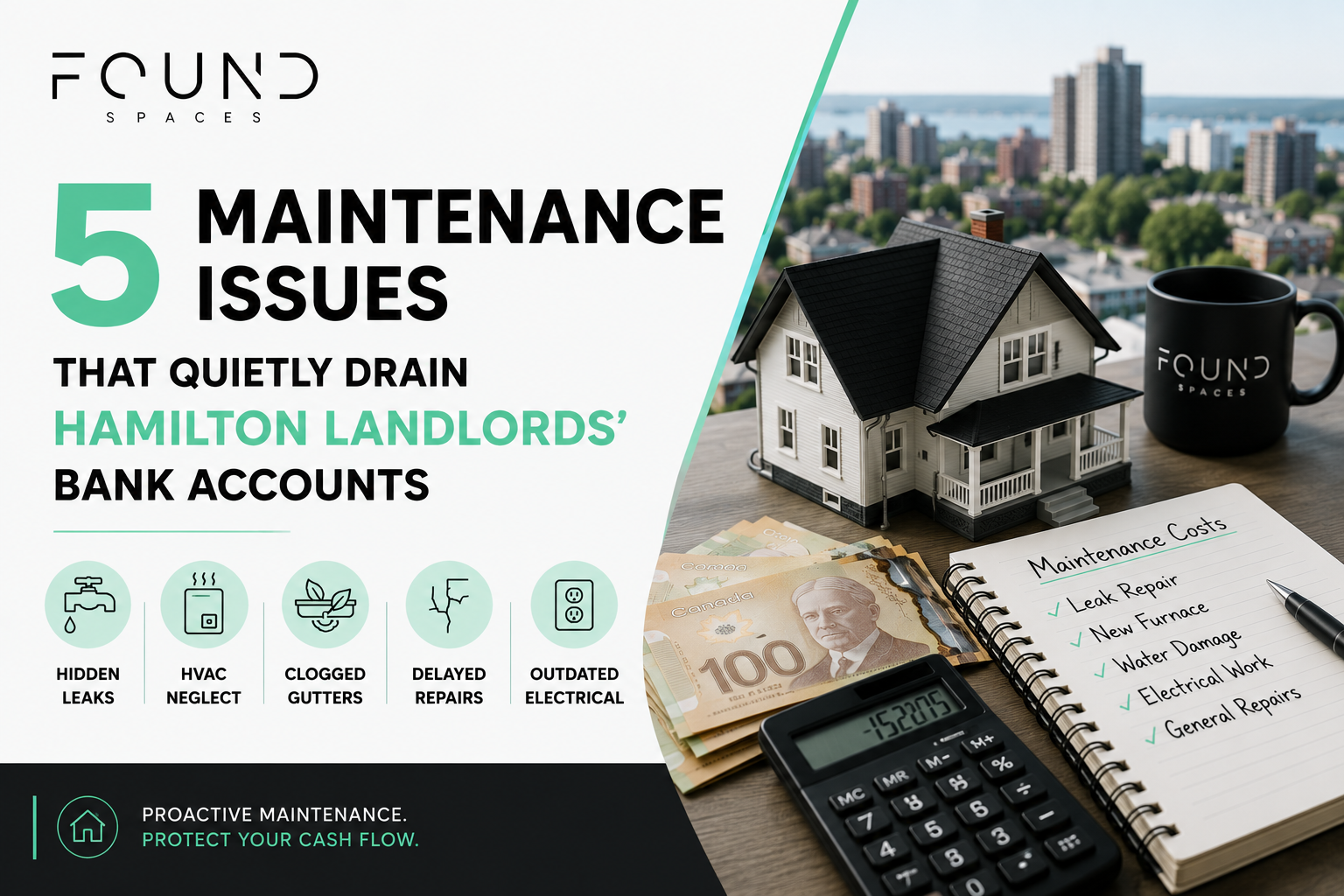
Here are the five that hurt Hamilton landlords the most, what they actually cost in 2026, and how to stop them from turning into a five-figure surprise. If you want a broader picture of how these fit into your operating budget, our rental property management team handles all of this day to day, but you can act on most of it yourself.
1. Roof leaks you can’t see yet
A full asphalt shingle roof replacement in Hamilton now runs between $12,000 and $20,000, depending on size, pitch, and how many layers have to come off. That number is bad enough. What makes it worse is the damage a slow leak does before anyone notices: soaked insulation, rotted decking, stained ceilings, and eventually mould.
The older east-end housing stock in wards 3 and 4 is where I see this most. Century homes with roofs that were “good for a few more years” three owners ago.
Book a roof inspection every spring. Ask the roofer to photograph the valleys, flashing, and any penetrations. A $200 to $400 inspection that flags a failing section lets you do a $1,500 repair instead of a $16,000 replacement plus interior restoration.
2. An aging furnace, which is also a legal problem
Most Hamilton homeowners pay $4,500 to $6,500 to replace a mid-efficiency gas furnace, and a full furnace-and-AC system can reach $18,000. If yours is 15 years old, plan for it now rather than in January.
Heat is not optional in a rental. Under section 20 of the Residential Tenancies Act, a landlord must keep the unit in a good state of repair, and heat is a vital service you cannot withhold. If you provide heat, it has to hit at least 20 degrees Celsius from September 1 to June 15. Tribunals Ontario spells this out in its maintenance and repairs guidance. A furnace that dies in a cold snap is not just a repair bill. It is a tenant with no heat, a possible LTB application, and rent abatement if you drag your feet.
Service the furnace every fall. Replace the filter on schedule. And take the Enbridge and Greener Homes rebates while they exist. A high-efficiency swap can pull $6,500 or more back into your pocket.
3. Water damage from plumbing you never touched
This is the one that turns a quiet month into a nightmare. A burst supply line, a failed hot water tank, or a slow leak under a kitchen sink can cause $3,000 to $8,000 in restoration for a moderate case, and a flooded finished basement can run $12,000 to $18,000 once you factor in drying, demolition, and rebuild.
Hamilton’s older homes often still have the original galvanized or poly supply lines and shutoff valves that seize the moment you touch them. The braided hoses behind a washing machine or under a sink are a common failure point and cost about $15 to replace.
Walk every unit at least twice a year. Check under sinks, around the hot water tank, and behind the washer. Replace supply hoses that are more than five years old. If you own in the lower city, budget for a backwater valve, because Hamilton’s older combined sewers back up during heavy storms.
4. Knob-and-tube and overloaded electrical
Hamilton has one of the older housing stocks in Ontario, and a lot of pre-1950 homes still have knob-and-tube wiring or a 60-amp service. Insurers increasingly refuse to cover them, or they cancel mid-term when they find out. A full rewire on a two-storey home runs $8,000 to $15,000, and a panel upgrade to 100 or 200 amps is usually $2,000 to $4,000.
The risk here is not just cost. It is fire, liability, and a coverage gap that leaves you exposed if something goes wrong.
Have an electrician assess any home built before 1960. If you find knob-and-tube, get a plan and a quote before your insurer forces the issue. Handling the LTB and compliance side of an aging building is exactly the kind of thing our landlord legal and LTB support team deals with when maintenance disputes escalate.
5. Basement water and foundation drainage
The Hamilton lower city sits on clay soil that holds water against foundations. Chronic basement moisture destroys finished space, feeds mould, and eventually cracks the foundation. Interior waterproofing and a sump pump can start around $3,000 to $6,000. Exterior excavation and weeping tile replacement climbs past $15,000.
A sump pump with install averages about $1,200, and a battery backup for it is cheap insurance against a power outage during a storm.
Grade the soil away from the foundation, keep downspouts extended well past the wall, and clean the gutters twice a year. Most basement flooding I see traces back to water pooling right against the house, not some deep structural failure.
Why we budget instead of react
The landlords who do well over ten years are the ones who treat maintenance as a scheduled cost, not a series of emergencies. We set aside a reserve on every property we manage, run seasonal inspections, and keep a record of the age of every roof, furnace, and hot water tank so nothing catches us off guard.
That record is the whole game. When you know a furnace is 14 years old, you replace it in September on your terms. When you don’t, it fails in a deep freeze and you pay premium rates for an emergency call plus a rent abatement.
Good rental property maintenance in Hamilton is unglamorous. It is inspections, records, and small repairs done on time. It is also the difference between a rental that earns and one that bleeds.
If you want a second set of eyes on your properties before the fall inspection season, reach out. Happy to walk through what we look for, whether or not you ever hand over the keys.

Kate Mackay is the founder and CEO of Found Spaces Property Management, managing over 600 rental units across Hamilton, Stoney Creek, Ancaster, Dundas, and the greater Hamilton area. She built Found Spaces from the ground up starting in 2017 and specializes in full-service property management for residential landlords and real estate investors.