Rent is due on the first. It shows up on the ninth. Then the twelfth. Then the eighth again. The tenant always pays, so an N4 gets you nowhere, and every month you cover the mortgage out of your own account for a week and a half while you wait. This is persistent late rent Ontario at its most familiar.
For years that was one of the most frustrating positions a Hamilton landlord could be in. The Residential Tenancies Act let you serve an N8 for “persistent” late payment, but nobody could tell you what persistent meant. I have seen LTB members rule that three late payments in a row were not persistent in a ten-year tenancy. Since September 21, 2026, that guesswork is gone.
What changed on September 21, 2026
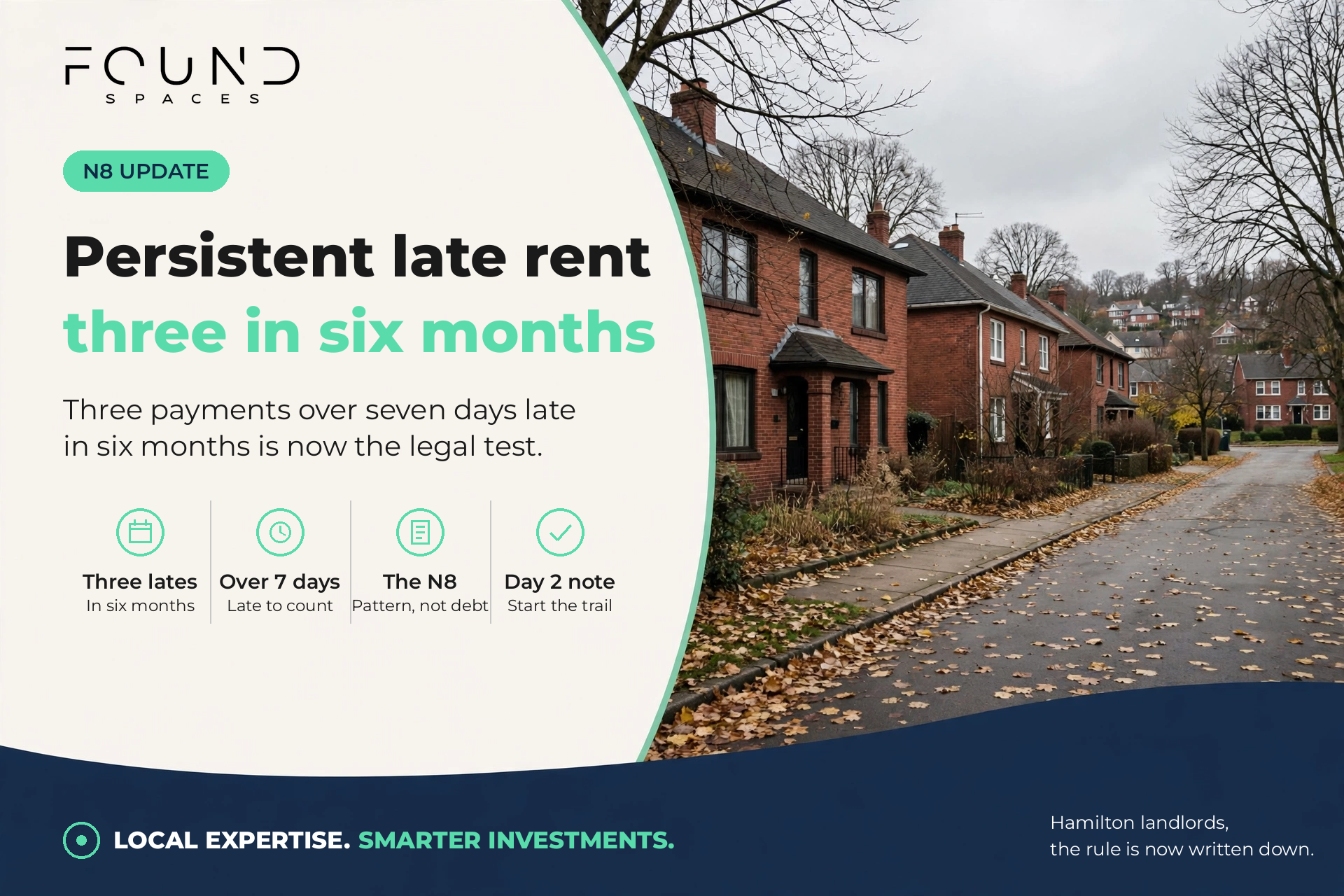
Ontario Regulation 241/26 added section 8.1 to the general regulation under the RTA. A persistent failure to pay rent on time now includes a tenant who pays more than seven days late on at least three occasions within any six-month period. The exact wording is on the Ontario e-Laws page for O. Reg. 241/26. That definition is the new test for persistent late rent Ontario.
Three details matter more than the headline.
The late payments do not have to be consecutive. January, March and June count.
A late payment does not count if it only exists because you applied the tenant’s money to an older balance. If a tenant pays full April rent on April 1 and you post it against February’s arrears, April is not late. The ledger has to show a real failure to pay.
The three-in-six benchmark is a floor, not a ceiling. The regulation says persistent late payment can still arise in other circumstances. A tenant who pays five days late every month for a year still fits the older case-by-case test.
This came in alongside the shorter N4 period and the other Bill 60 changes to how fast cases move. Our post on LTB hearing timelines after Bill 60 covers what a filing looks like now.
Why the N8 is a different tool than the N4
An N4 is about money owed, and the tenant voids it by paying. An N8 is about a pattern, and the tenant cannot void it by catching up. You can serve an N8 on a tenant who owes you nothing today. Persistent late rent Ontario is exactly the pattern the N8 was made for.
The N8 ends the tenancy at the end of the term. For a monthly tenancy that means at least 60 days’ notice, with the termination date on the last day of a rental period. A notice served on November 25 cannot have a termination date earlier than January 31, 2027. Daily and weekly tenancies need 28 days.
If the tenant stays past the termination date, you file an L2 with the Landlord and Tenant Board. The fee is $186 through the Tribunals Ontario Portal or $201 on paper.
The member still has discretion under section 83. In practice, most first-time N8 cases end in a conditional order: pay on time for twelve months, or the landlord can file for eviction without a new hearing. That is usually the better outcome for a landlord. It fixes the behaviour without a vacancy.
What your ledger needs to show
The case lives or dies on the rent ledger. For every payment the member will look for the due date, the date received, the amount, and what it was applied to.
A folder of e-transfer screenshots is not a ledger. If you collect rent in cash, stop. There is no clean way to prove a cash payment date at a hearing.
Count the days properly. A payment on the eighth is late. A payment on the seventh is not. That count is what proves persistent late rent Ontario.
A Ward 3 example from this fall
In August we took over a six-unit building on a side street off Barton Street East, in Ward 3, where the previous self-managing owner had one tenant paying between the 9th and 15th of every month for over a year. Rent was $1,650. The owner had served two N4s, both voided by payment, and had given up.
We rebuilt the ledger from the owner’s bank records, confirmed four payments more than seven days late in the previous six months, and served an N8 on September 22 with a termination date of November 30. The L2 goes in on December 1, and our paralegal will ask for a conditional order rather than a straight eviction. That ledger proved persistent late rent Ontario over the previous six months.
The tenant paid on the first in October and again in November. First time in eighteen months. The notice was credible for the first time, and the behaviour changed before anyone sat in front of a member.
The sequence we run on every late payment
The N8 is the last step, not the first. This is what happens on a late rent across the 600+ units Found Spaces manages. It is how we handle persistent late rent Ontario across the portfolio.
Day 2: written reminder
A short, dated message by email or through the tenant portal. No threats. This starts the paper trail.
Day 4: phone call
Most late rent is a logistics problem: a new job, a changed pay date. A tenant paid biweekly on a Friday who keeps missing the first is not a bad tenant. They are a scheduling problem, and sometimes a different due date fixes it for both sides.
Day 8: the N4
The N4 goes out every time, even when we expect payment, because each served N4 is dated evidence for a later N8.
Third late payment in six months: the N8
Once the ledger shows three payments more than seven days late inside a six-month window, we serve the N8 and file the L2 the day after the termination date. We do not wait for a fourth.
Leave the last month’s rent deposit alone
The last month’s rent deposit covers the last month of the tenancy and nothing else. You cannot apply it to a late February payment, and there is no damage deposit in Ontario. Treat it that way in your ledger or you hand the tenant an argument at the hearing. Getting this wrong can weaken a persistent late rent Ontario case.
What persistent late rent Ontario means if you self-manage in Hamilton
Hamilton’s purpose-built vacancy rate rose to 3.6% in 2025 and the average two-bedroom rent was $1,656, according to CMHC’s rental market report. A unit sitting empty on the Mountain or in the east end for two months costs more than most late-payment problems do. That is the argument for the conditional order over the eviction, and it is why we start with a phone call.
But the new rule removes the main excuse for tolerating a chronic late payer. The RTA now tells you exactly what pattern is enough. The only question is whether your ledger can prove it. For persistent late rent Ontario, the pattern is now defined.
We handle N4s, N8s, L1 and L2 filings and hearing representation through our landlord legal services for the owners we manage. If you are weighing whether to keep self-managing, how to choose a property manager in Hamilton covers the questions to ask, including how a manager tracks rent.
If you have a tenant who has paid you on the tenth for a year, send us the last six months of bank statements. We will tell you whether you have an N8 case and what we would do with it. That is how we assess persistent late rent Ontario.
Kate Mackay
Founder & CEO, Found Spaces Property Management Inc.
[email protected] | (289) 270-2922

Kate Mackay is the founder and CEO of Found Spaces Property Management, managing over 600 rental units across Hamilton, Stoney Creek, Ancaster, Dundas, and the greater Hamilton area. She built Found Spaces from the ground up starting in 2017 and specializes in full-service property management for residential landlords and real estate investors.