
If you’re a Hamilton landlord thinking about reclaiming a unit for yourself, your spouse, or a family member, the rules you knew six months ago aren’t the rules you’ll be working with this year.
The N12 eviction Ontario landlords use for personal-use notices has been one of the most procedurally strict tools in the Residential Tenancies Act for years. One date wrong, one missing affidavit, one cheque not paid on time, and the whole notice is void. Bill 60, which received Royal Assent in November 2025, changes a piece of that calculation. It’s not a small change. It’s a rethink of how landlords should time these notices.
I’m Kate Mackay, founder of Found Spaces Property Management. We manage over 600 rental units across Hamilton, Stoney Creek, Ancaster, Dundas, and the greater Hamilton area. I’ve watched dozens of N12 files go through the LTB, and I’ve seen every kind of mistake a self-managing landlord can make. The new rules give you a real strategic option, but only if you understand them properly.
What Bill 60 changed about the N12 eviction Ontario landlords use
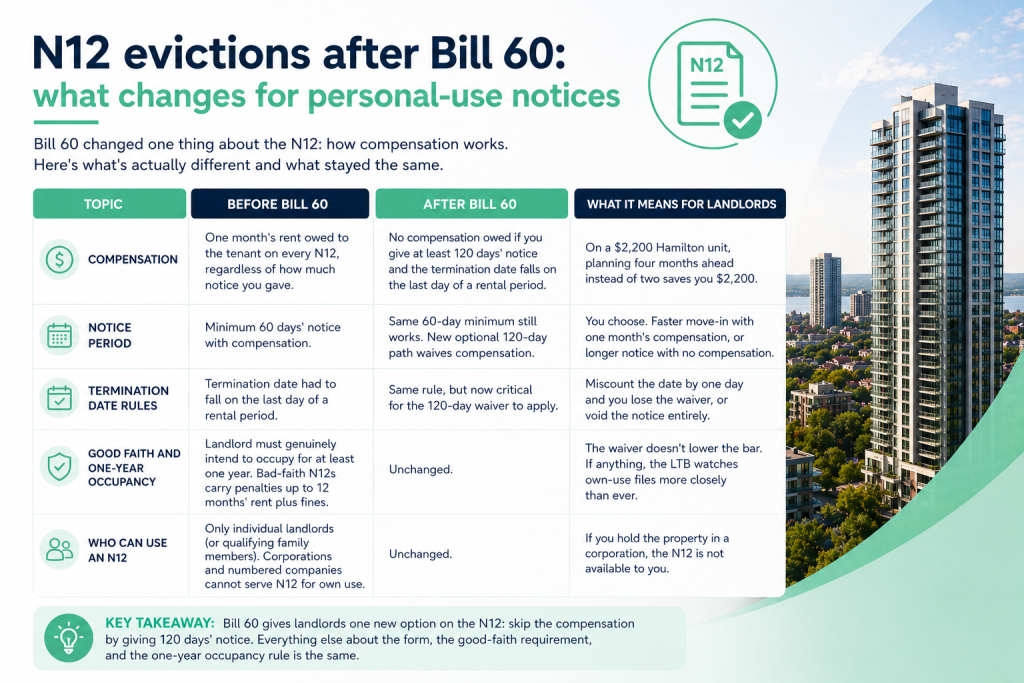
Before Bill 60, every N12 came with a flat compensation rule. Whether you gave 60 days’ notice or 200 days’ notice, you owed the tenant one month’s rent in compensation, paid or credited before the termination date. No exceptions. Most landlords handled this by waiving the last month’s rent deposit.
Bill 60 introduces a single carve-out. If you give at least 120 days’ notice, and the termination date falls on the last day of a rental period (or the end of a fixed-term lease), you no longer owe that one month’s compensation.
That’s it. That’s the entire change to the N12 process under Bill 60.
For a landlord reclaiming a Hamilton unit renting at $2,200 a month, that’s $2,200 you keep by planning four months ahead instead of two.
What hasn’t changed
Everything else about an N12 is the same:
- The person moving in still has to qualify under the RTA (you, your spouse, child, parent, or your spouse’s child or parent, plus a few specific others)
- They still have to genuinely intend to occupy the unit for at least one year
- You still have to sign an affidavit confirming good-faith intent
- Bad-faith N12s still carry serious penalties, including up to 12 months of rent in damages plus administrative fines
- A corporation, including a numbered company, still cannot serve an N12 for own use
The compensation waiver is a financial perk for landlords who plan ahead. It is not a relaxation of any other requirement.
The 120-day notice has to be exact
This is where most landlords are going to trip up. The 120-day rule sounds simple. It isn’t.
The termination date you pick must satisfy two conditions at the same time:
- It must be at least 120 days after you serve the notice.
- It must fall on the last day of a rental period, or the end of a fixed-term lease.
If your tenant pays rent on the first of every month, the rental period ends on the last day of the month. So a notice served on July 5 with a termination date of November 30 works. A notice served on July 5 with a termination date of November 5 does not, even though it’s more than 120 days out, because it doesn’t end on the last day of a rental period.
Get one of those two conditions wrong and you fall back to the old rule. You owe the one month’s compensation, or your notice is void entirely.
I’ve seen landlords miscount days. I’ve seen them serve notice by registered mail and forget that service rules add days. I’ve seen them pick a termination date based on the lease anniversary instead of the rental period. Each of those mistakes costs you the waiver, and sometimes costs you the entire eviction.
Why this matters more in this market
Here’s the part most landlords don’t want to hear.
The Hamilton rental market in 2026 is not the market most of you bought into. Vacancy rates are rising, rents are softening in several pockets of the city, and units are sitting longer than they used to. I’m getting calls from landlords who’ve owned rental property for 10 years and are seeing their first real vacancy. I’m getting calls from first-time landlords whose unit has been empty for six weeks and they don’t know why.
For a lot of landlords, the mindset shift is the hard part. We had a decade of rents going up every year and units leasing in days. Adjusting to a market where you have to compete for tenants, price strategically, and budget for vacancy is uncomfortable. It’s also reality.
What does this have to do with the N12? Two things.
First, if you’re reclaiming a unit because you genuinely need it, the 120-day route is almost always the smarter financial play in this market. You’re not in a rush. The unit isn’t going to lease for more in two months than it would in four. Take the longer notice, save the compensation, and use the extra time to plan your move properly.
Second, if you’re considering an N12 because the unit is underperforming and you want to “reset” it, stop. That’s exactly the use case the LTB scrutinizes hardest. Bad-faith findings have been climbing, and the financial exposure on a bad-faith N12 is far worse than just absorbing a year of below-market rent.
How we handle N12s for our owners
When one of our owners needs to reclaim a unit, we run the file through the same checklist every time. We confirm the relationship qualifies under the RTA. We pull the rental period from the original lease. We calculate the termination date manually and then we calculate it a second time. We draft the affidavit. We confirm the service method and document the date.
If the file qualifies for the 120-day waiver, we structure the notice to capture it. If it doesn’t, we make sure the compensation is paid or credited before the termination date, in writing, with proof.
This isn’t complicated work, but it’s exacting work. The kind of work that gets sloppy when you’re managing your own units around a full-time job and a family. We manage single-family rentals, small multi-units, and full portfolios across Hamilton, Stoney Creek, Ancaster, and Dundas precisely so owners don’t have to keep this in their head.
For the broader procedural changes in Bill 60 beyond the N12, we covered those here. For the full picture of what’s coming in 2026, see our Ontario rental regulations 2026 page.
A practical N12 eviction Ontario checklist before you serve
If you’re planning an N12 in the next six months, work through this before you fill out the form:
- Confirm the person moving in qualifies under the RTA
- Pull the lease and identify the rental period (almost always monthly, ending the last day of the month)
- Decide whether the 120-day waiver is worth waiting for, or whether 60-day notice with compensation is the better play
- Calculate the termination date twice
- Prepare the affidavit before you serve the notice, not after
- Document service method and date
- If you’re using the 120-day waiver, do not pay compensation. If you’re under 120 days, pay or credit it before the termination date in writing
- Keep a clean rent ledger in case the file ends up at the LTB
If you’d rather not do this alone
The N12 is one of the highest-stakes notices a landlord can serve. The compensation waiver under Bill 60 is a real opportunity, but only if the notice is built correctly. If you want a second set of eyes on a file you’re considering, or you want a property manager handling the whole process, reach out. No pitch. Just a conversation about where you stand and what makes sense for the unit.
Found Spaces Property Management [email protected] | (289) 270-2922

Kate Mackay is the founder and CEO of Found Spaces Property Management, managing over 600 rental units across Hamilton, Stoney Creek, Ancaster, Dundas, and the greater Hamilton area. She built Found Spaces from the ground up starting in 2017 and specializes in full-service property management for residential landlords and real estate investors.