
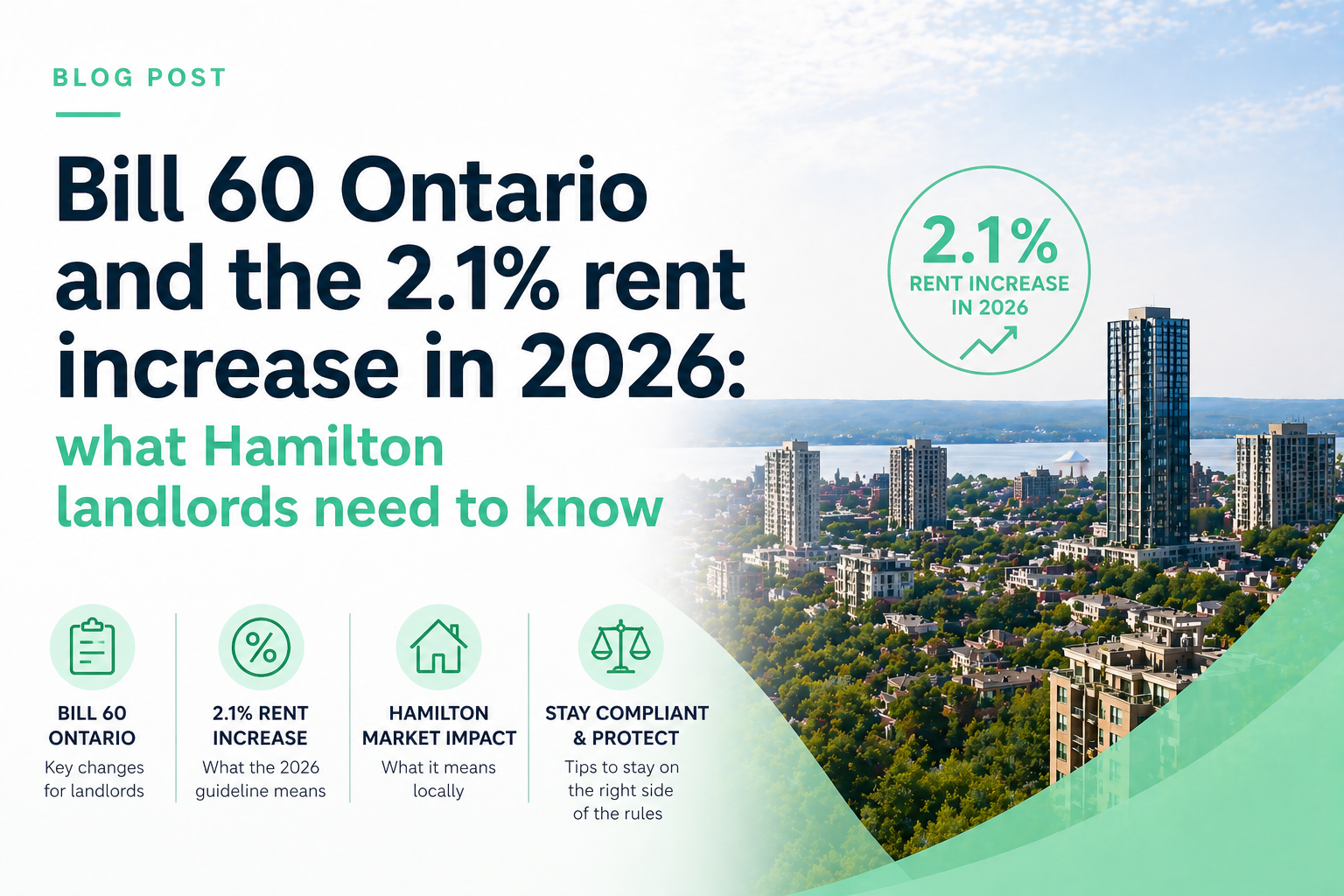
If you own a rental property in Hamilton, two things are happening at the same time this year. The Ontario rent increase 2026 guideline is set at 2.1% and is already in effect. However, Bill 60’s changes to the Residential Tenancies Act are law but not yet active. Many landlords searching for property management in Hamilton run into this exact issue.
That second part is where landlords keep getting confused.
I’m Kate Mackay, founder of Found Spaces Property Management. We manage over 600 rental units across Hamilton, Stoney Creek, Ancaster, Dundas, and the greater Hamilton area. And we’ve been getting a lot of questions about Bill 60 since it received Royal Assent in November 2025. The most common one: “Does this change how I raise rent?”
The short answer is no. The 2.1% rent increase for 2026 and Bill 60 are separate. But they overlap in ways that matter if you’re running a rental portfolio in Hamilton right now.
The Ontario rent increase 2026 guideline is set at 2.1% and is already in effect
The Ontario rent increase 2026 guideline is one of the most common questions we’re getting from Hamilton landlords right now. The Ontario rent increase guideline for 2026 is 2.1%. That’s the maximum you can raise rent on an existing tenant without Landlord and Tenant Board approval. It applies to most units first occupied on or before November 15, 2018.
For a tenant paying $2,000 per month, that’s a $42 increase. For a portfolio of 10 units, it adds up to roughly $5,000 in additional annual revenue if you serve notice correctly.
The rules haven’t changed here. You still need 90 days’ written notice on Form N1. You still need to respect the 12-month rule. And you still need to calculate from the actual rent amount, not a rounded figure. One day short on notice and the entire increase is void.
If your unit was first occupied after November 15, 2018, it’s exempt from the guideline. You can increase by any amount with proper notice using Form N2. We see a lot of Hamilton landlords with post-2018 builds in Stoney Creek and on the Mountain who don’t realize this exemption applies to them.
Bill 60 Ontario: what passed, what hasn’t started yet
Bill 60, the Fighting Delays, Building Faster Act, received Royal Assent on November 27, 2025. It amends 16 statutes. The part that affects landlords and tenants is Schedule 12, which rewrites sections of the RTA dealing with evictions, hearings, and LTB procedures.
As of now, the RTA changes under Schedule 12 are not in force. They require a proclamation date from the provincial Cabinet, and that date hasn’t been announced. The existing RTA rules still apply to every active tenancy and every open LTB application.
But the changes are coming. When they take effect, here’s what shifts.
Four Bill 60 changes Hamilton landlords should prepare for
The N4 notice period drops from 14 days to 7. Right now, when you serve an N4 for non-payment of rent, the tenant has 14 days to pay before you can file an L1 application with the LTB. Bill 60 cuts that to 7. For landlords chasing arrears across multiple units, this halves the wait.
Tenants must deposit 50% of arrears to raise maintenance issues at a hearing. Under the current system, a tenant can show up to a non-payment hearing and raise maintenance complaints they’ve never documented. The hearing gets adjourned, the eviction stalls, and the landlord loses months. Bill 60 changes this. If a tenant wants to raise maintenance as a defence during a rent arrears hearing, they’ll generally need to deposit half the alleged arrears into the Board’s trust first.
We’ve dealt with this exact scenario in Hamilton more times than I can count. A tenant gets an N4, shows up at the hearing, and suddenly there’s a list of maintenance issues that were never reported. This change won’t stop legitimate complaints. But it should stop the tactical delays.
N12 compensation can be waived with 120 days’ notice. Currently, landlords must pay one month’s rent as compensation when evicting for personal use (N12). Under Bill 60, if you give 120 days’ notice instead of the standard 60, you don’t owe that compensation. For a landlord moving a family member into a Hamilton rental where the rent is $2,200 per month, that’s $2,200 saved by planning further ahead.
The LTB review period shrinks from 30 days to 15. If a tenant wants to challenge an LTB eviction order, the window to file a review request drops in half. For landlords, this means enforcement timelines tighten. Orders can move to sheriff enforcement sooner.
How Bill 60 and the 2.1% rent increase work together
These two pieces of Ontario rental law don’t directly connect. The 2.1% rent increase for 2026 is a standalone guideline under the RTA. Bill 60 doesn’t change rent control percentages.
But here’s where they intersect in practice.
If you’re raising rent and a tenant falls behind, the Bill 60 changes (once in force) will speed up your options. The N4 timeline cut means you can file an L1 application a full week sooner. The 50% arrears deposit rule means hearings are less likely to derail over unrelated complaints. Together with the 2.1% increase, your ability to maintain predictable cash flow from a Hamilton rental tightens up.
For landlords in Hamilton’s rental market, where average rents hit $2,069 per month in 2026 and vacancy sits around 3.6%, these procedural changes matter. The difference between collecting rent on time and waiting four months through an LTB backlog is the difference between a performing asset and a problem property.
What to do right now (before Bill 60 takes effect)
You don’t need to wait for proclamation to start preparing. Here’s what we’re telling our Hamilton landlords.
Serve your 2026 rent increases now if you haven’t. The 2.1% guideline is already active. If you missed the 90-day notice window for a spring increase, start the clock for a fall one. Every month you delay is money left on the table. Use the correct Form N1 and keep a copy of the served notice.
Clean up your rent ledgers. When Bill 60’s N4 changes kick in, your arrears documentation needs to be tight. The LTB will dismiss applications where the ledger is messy or charges are unclear. If you’re tracking rent on a spreadsheet, move to a proper system. If you’re working with a property management company, confirm how they track and report arrears.
Audit your CO alarm compliance. This one flies under the radar. As of January 1, 2026, the Ontario Fire Code requires a working carbon monoxide alarm on every storey of a rental property that has a fuel-burning appliance or attached garage. That includes the basement and main floor, not just bedrooms. Insurance claims have been denied over this. Don’t skip it.
Review your N12 strategy. If you’re planning to move a family member into a unit, the 120-day compensation waiver under Bill 60 changes how you time your notice. Plan ahead and talk to a paralegal or your property manager before serving anything.
Why this matters more for Hamilton
Hamilton’s rental market is different from Toronto’s. We have older housing stock, smaller portfolios, and a high concentration of self-managing landlords. Many of the landlords I talk to own two to five units. They don’t have in-house legal teams or property management software.
That’s the gap Bill 60 exposes. The new rules reward landlords who keep clean records, serve proper forms, and hit their timelines. They punish the ones who wing it.
In Wards 1, 8, and 14, landlords also have rental licensing requirements on top of all this. The compliance load is real.
At Found Spaces, we built our systems around exactly this. Every lease, rent increase, N4 notice, and maintenance request runs through a documented process. Whether you own a duplex in the lower city or a single-family rental in Ancaster, the workflow is the same. When a file goes to the LTB, the paperwork is already done.
I founded this company in Hamilton because I saw landlords losing money to avoidable mistakes. That hasn’t changed. The rules just got more specific.
The bottom line
The 2.1% rent increase for 2026 is straightforward. Serve your N1, respect the 90-day notice, follow the 12-month rule. Bill 60 is more complex, but the preparation is the same: clean records, correct forms, and a system that doesn’t rely on memory.
If you’re managing rental properties in Hamilton and you want to talk through how these changes affect your portfolio, reach out. No pitch. Just a conversation about where you stand.
Found Spaces Property Management [email protected] | (289) 270-2922

Kate Mackay is the founder and CEO of Found Spaces Property Management, managing over 600 rental units across Hamilton, Stoney Creek, Ancaster, Dundas, and the greater Hamilton area. She built Found Spaces from the ground up starting in 2017 and specializes in full-service property management for residential landlords and real estate investors.