I’ve been getting more calls about rental licensing in Hamilton in the last four months than in the entire two-year pilot.
That tells you something. Either landlords ignored the pilot and are now panicking, or the City is enforcing this differently as a permanent program. From what I’m seeing on the ground, it’s both.
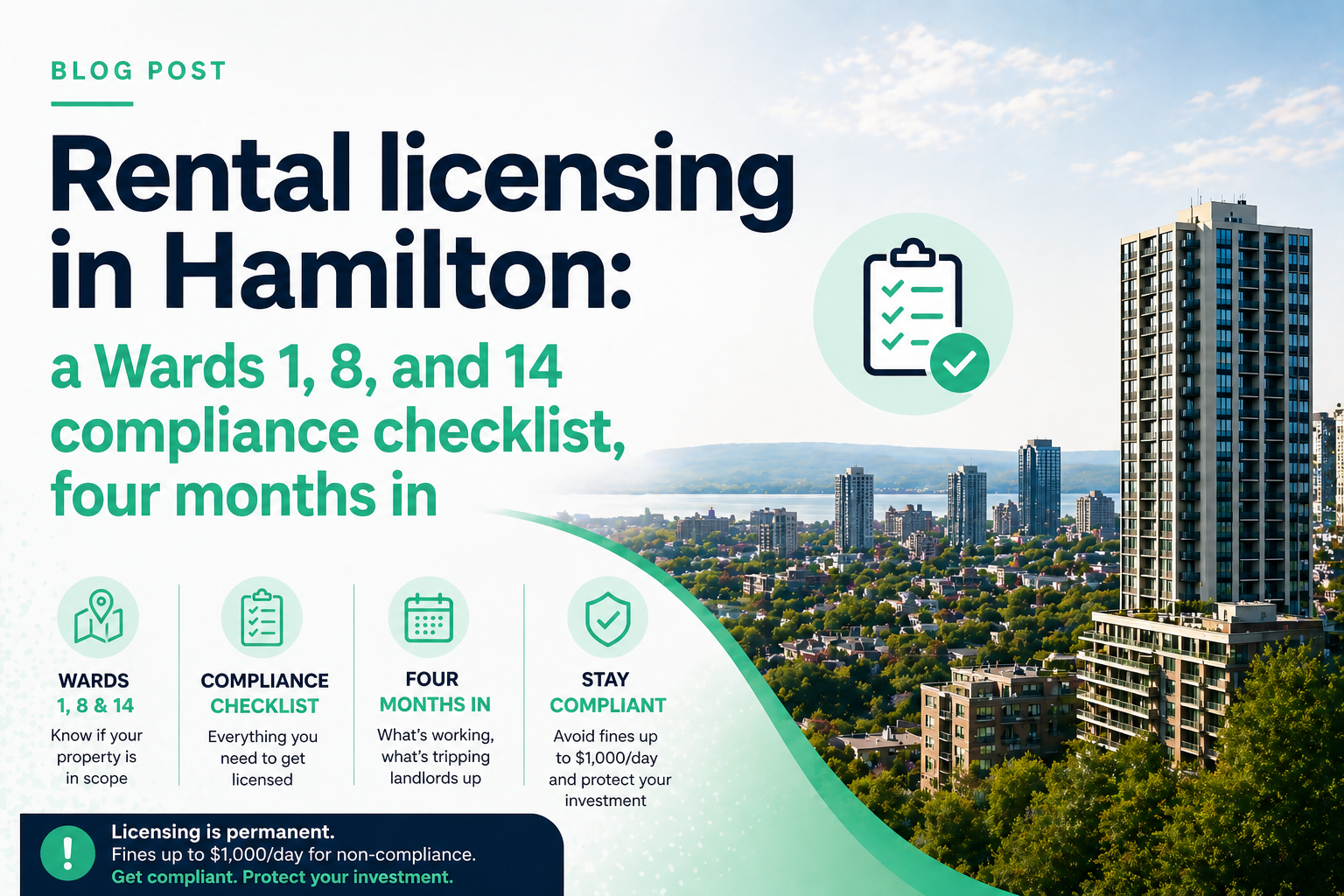
If you own a rental in Wards 1, 8, or parts of Ward 14 with five or fewer self-contained units, you needed a licence as of January 1, 2026. If you don’t know your ward off the top of your head, this is roughly: Ward 1 covers Westdale, Ainslie Wood, Kirkendall, and the Chedoke-Cootes area around McMaster. Ward 8 covers the west and central Mountain neighbourhoods near Mohawk College — Westcliffe, Buchanan, Yeoville, Gilkson, and Bonnington. The portion of Ward 14 in scope is the section nearest McMaster and Mohawk, not the full ward. If you’re unsure, the City has a licensing map where you can punch in your address. Fines run up to $1,000 a day for operating without a licence. And the City has been issuing notices.
Here’s what the last four months have actually looked like for landlords we work with, what’s tripping people up, and a clean checklist to get compliant if you’re behind.
What changed when rental licensing in Hamilton went permanent
The pilot ran from January 2024 to December 2025. During that time, the City received about half the applications they expected. Compliance was patchy. Some landlords took it seriously. Plenty waited to see if it would die.
It didn’t die. In December 2025, City Council voted to make the program permanent and signalled they may expand it to other wards. The same five-or-fewer-unit threshold applies. Detached homes and townhouses count. The required documents are the same. The fines are the same.
What’s different now is the energy behind enforcement. The City is sending door knockers, cross-referencing utility records, and acting on tenant complaints. If you’ve never applied, you are visible.
Where landlords are getting stuck
Four common problems I keep running into:
The $2 million liability insurance requirement
Most landlords carry standard rental property insurance. The licence requires a specific Certificate of Insurance naming the property as a rental, with $2 million per occurrence in liability coverage. Your broker can issue this in a day. But if you don’t ask, you don’t get it. I’ve seen applications sit for weeks because the insurance certificate was for the wrong policy type.
The floor plan
You need a detailed floor plan showing each room, its dimensions, and proposed use. The number and location of bedrooms must be clear. This is where a lot of older Hamilton homes run into trouble — basement units that were finished decades ago, attic conversions, additions that don’t match what’s on file with the City. If your plan shows a “bedroom” in a basement that doesn’t meet egress requirements, you’ve just told the inspector you have a problem.
The fire inspection
Hamilton Fire Department schedules a separate inspection from the property standards inspection. They check smoke alarms, CO detectors, fire separations, exit routes, and Section 9.3 of the Ontario Fire Code if your unit could be classified as a lodging house. If your detectors are hardwired but interconnected wrong, or if a basement unit doesn’t have proper egress, you’re looking at orders that have to be cleared before the licence is issued.
The Certificate of Compliance
A Licensing Compliance Officer does a Property Standards inspection. Anything from a missing handrail to peeling exterior paint can generate an order. None of these are difficult to fix. They just take time and slow your application down if you weren’t ready.
The compliance checklist
If you’re starting from zero, here’s what you need:
- Completed business licence application
- Proof of ownership (registered deed or property tax bill)
- $2 million liability insurance certificate naming the property as a rental
- Detailed floor plan with room dimensions and uses
- Self-Certification Checklist completed per the by-law
- Property Standards inspection passed (or orders cleared)
- Fire Safety inspection passed (or orders cleared)
- Licence fee paid
For corporations, you also need head office address, director and officer details, and a Certificate of Status from the Ministry of Public and Business Service Delivery.
Get the floor plan and insurance certificate in hand before you submit anything. Those are the two items that delay applications most often.
What I tell landlords who are behind
If your property is in scope and you don’t have a licence yet, apply now. The City allows units to remain rented during the application process unless an inspection turns up immediate health and safety violations. Applying voluntarily is treated very differently than getting caught.
If you’re not sure whether your property is in scope, the City’s licensing map lets you enter your address. Wards 1 and 8 are largely covered. Ward 14 is partial — the parts near McMaster and Mohawk are in, the rest mostly aren’t.
If you’ve already had an inspection and are sitting on orders, fix what you can immediately and document the rest. Inspectors give reasonable timelines for legitimate work, but they expect to see progress.
The bigger picture
This is happening at the same time as a market shift most landlords didn’t see coming. Vacancies are up to 3.6%. This is the highest vacancy rate since the pandemic. Rents have softened in some segments. Bill 60 changed how N4 and N12 timelines work. The 2026 rent increase guideline is 2.1%.
I’ve been doing this for over a decade. I have landlords who’ve owned rentals for twenty years sitting across from me genuinely unsettled — first time they’ve had a unit empty for more than a month, first time they’ve had a tenant push back hard on a lawful rent increase, first time they’ve had to budget for licensing compliance on top of everything else.
The mindset adjustment is the hard part. For a long stretch in this market, holding a rental in Hamilton was largely passive. Rents went up. Tenants stayed. Compliance was light. None of those three things are still true. Licensing is one piece of a regulatory tightening that is not going away.
The landlords who are coping well are the ones who treat this as an operating discipline, not a hassle. Clean records, current insurance, accurate floor plans, fast response to inspection orders. The ones struggling are the ones who treated their rental like a bank account and now find out the bank has rules.
How we handle this for our owners
At Found Spaces, we manage over 600 units across Hamilton, Stoney Creek, Ancaster, Dundas, and the surrounding area. For properties in Wards 1, 8, and 14, we handle the licensing process from address verification to certificate in hand. That includes coordinating the insurance certificate, preparing the floor plan, walking the property before inspections to flag obvious orders, and managing the paperwork.
If you own a single-family rental or a small multi-unit in scope, the process is the same. We do it weekly.
If you’ve got a property in Wards 1, 8, or parts of Ward 14 and you’re not sure where you stand, reach out. I’d rather have a 15-minute conversation now than a $1,000-a-day fine to clean up later.

Kate Mackay is the founder and CEO of Found Spaces Property Management, managing over 600 rental units across Hamilton, Stoney Creek, Ancaster, Dundas, and the greater Hamilton area. She built Found Spaces from the ground up starting in 2017 and specializes in full-service property management for residential landlords and real estate investors.